HR and payroll explained: Roles, workflows, and best practices


Treating HR and payroll as separate departments might look organized on paper, but it’s usually what leads to inconsistencies that drain your team’s time. HR teams can’t rely on “manual bridges” or endless spreadsheet comparisons to stay accurate. They need a single, reliable flow where a contact or title change happens once, then updates everywhere automatically.
When that flow breaks, misalignment can create costly errors and trust issues among the staff. In fact, 21% of employees reported losing trust in their employers due to a payroll issue, and 64% felt financial strain from late or incorrect paychecks. 53% would consider leaving if those mistakes happened multiple times.*
In this article, we’ll get into how HR and payroll work together and discuss the best practices for building a coordinated infrastructure.
* HRMorning, 2025
What are HR and payroll?
Human resources, or HR, manages the employee lifecycle. HR teams recruit, onboard, and provide benefits to new hires. Later, the team’s primary purpose shifts to help those recruits perform at their best while keeping the organization aligned with labor laws.
Payroll, on the other hand, keeps track of what employees are owed. This team manages wage calculations, statutory deductions, and taxes, and distributes accurate compensation to employees so they’re paid correctly and on time. While you can tackle some of these tasks in HR processes, payroll is what normally handles them separately.
HR vs. payroll: How are they different?
While some people assume that HR does payroll — and for some smaller organizations, they can — the two teams are actually built on very different foundations. HR revolves around human behavior and talent management, while payroll is rooted in mathematical precision and rigid regulatory frameworks.
Here’s how payroll and human resources compare in practice:
- Day-to-day tasks: HR handles workforce management and enforces company policies. Payroll calculates and distributes salaries, including handling tax/other deductions and benefit distributions.
- The rules they follow: While HR monitors employment laws and employee relations, payroll focuses on payroll taxes and financial reporting requirements.
- How the work changes as companies grow: In small businesses, an operations manager or generalist often handles payroll management in HR. As companies scale, this ownership typically splits: HR drives talent strategy, while finance and payroll specialists process compensation.
- Ultimate goals: For HR, success looks like a happy and productive team that sticks around. For payroll, good performance means the math is perfect every time and every paycheck arrives when it’s expected.
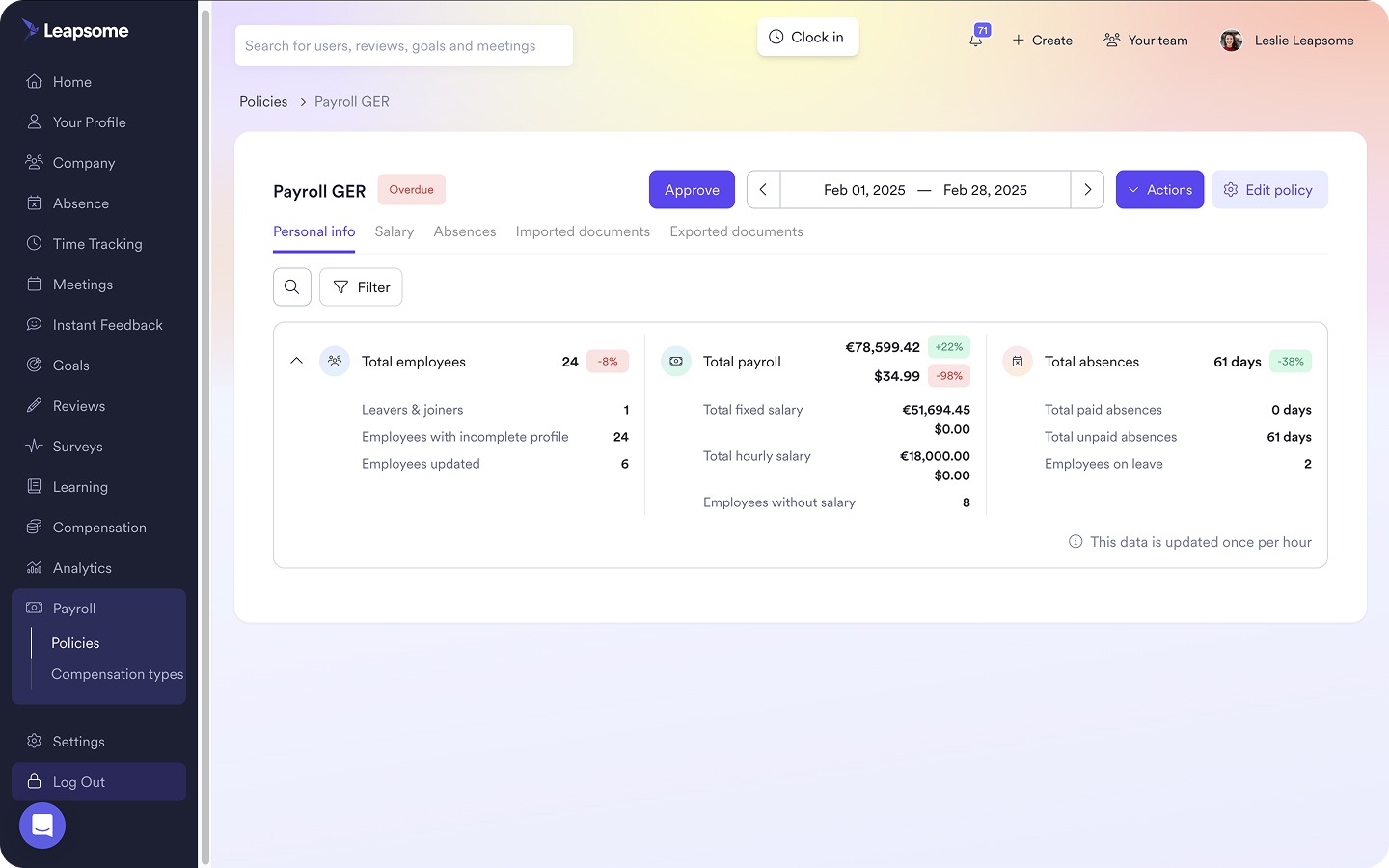
📝 Streamline your data for error-free payroll
Leapsome securely stores your compensation and policy data in one place using DATEV integration for direct data transfers, so payslips stay as accurate as possible.
👉 Explore Payroll Prep
How HR and payroll work together
HR and payroll workflows overlap at several points in the employee lifecycle:
- Setting up a new hire: HR collects tax documents and banking details to feed directly into the payroll system.
- Updating pay for a promotion: HR often makes the final call on promotions and salary adjustments, and payroll reflects those changes in the next cycle.
- Time off and benefits administration: While HR tracks medical deductions and unpaid leave, payroll calculates what time was paid and unpaid, then updates net pay correctly.
- The final goodbye: HR processes departures, and payroll issues accurate final paychecks in line with statutory deadlines.
A functioning payroll system relies on HR submitting tax documents and time off pay differences in a timely manner. If communication breaks down between payroll and HR, the rest of the organization feels the disconnect, too.
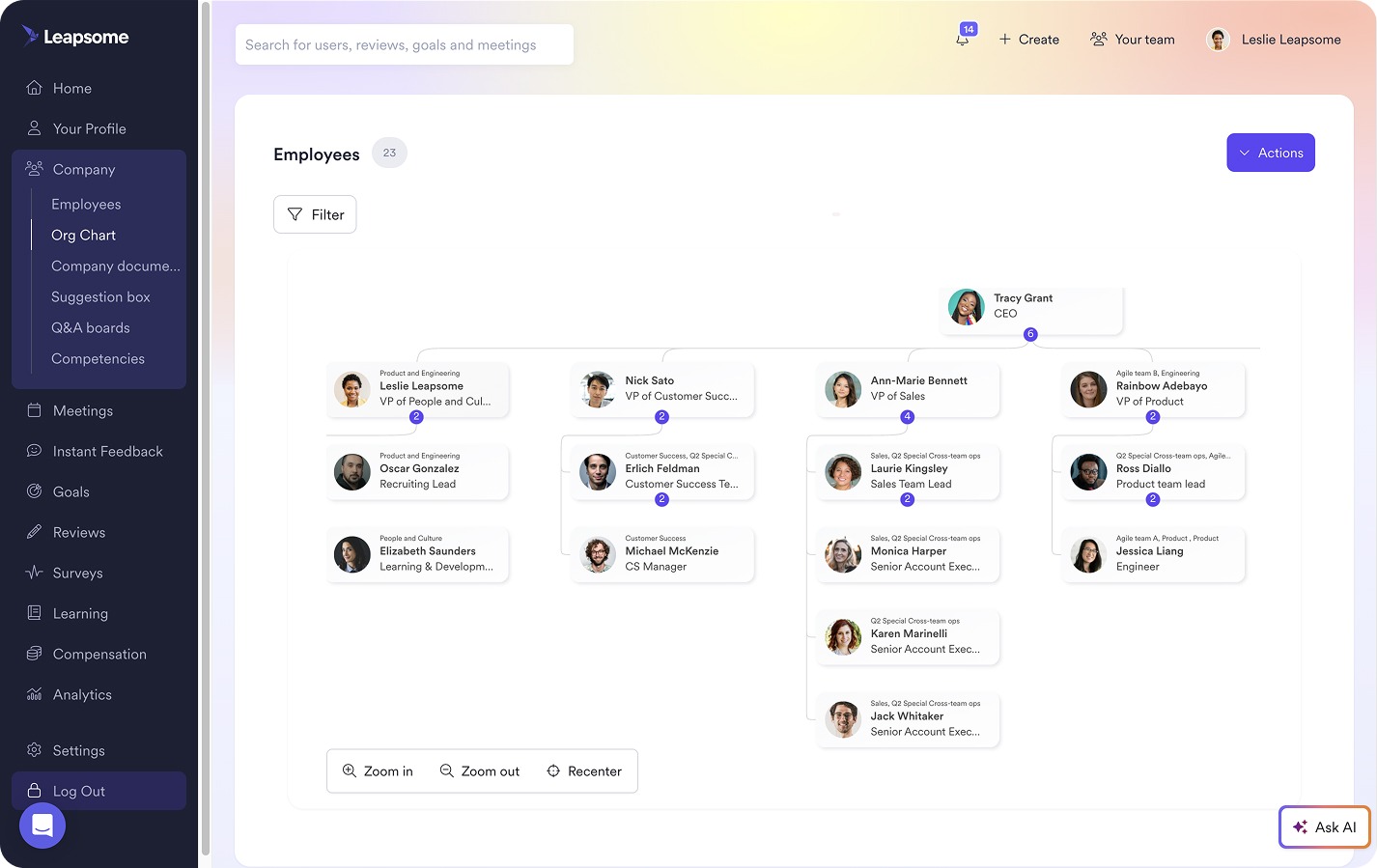
🎯 Centralize your people data
Leapsome centralizes employee records, helping HR teams maintain accurate workforce data that supports payroll and reduces manual update frequency.
👉 Explore Employee Records
The high price of having disconnected systems
“Many HR teams still struggle with the basics — too many disconnected tools, limited insights. That’s why we built a truly people-first HRIS that unifies all employee data into one source of truth.”
— Suraj Paneru, Customer Success Coach at Leapsome
Nobody walks into the office hoping to mess up, yet in the United States, one in five payroll runs contain errors — and each of those mistakes carries a $291 price tag (on average).
When HR and payroll teams don’t have a single source of truth, you’re less likely to catch these mistakes, and your profit margins and company culture may suffer. The disconnect often creates several other issues, too:
- Scattered employee data: Important bits of employee data often end up across different platforms or tools. This forces teams to waste time manually cross-referencing records, and may lead to mismatched data.
- Outdated records: If a change to an employee’s status doesn’t get to the payroll system on time, the run happens on old data. This creates a cycle of retroactive adjustments and “catch-up” payments just to fix the books.
- The risk of the manual “bridge”: Relying on someone to hand-type data between systems is an open invitation for mistakes. Over time, even small oversights or typos can lead to penalties or even draw attention from regulatory agencies.
A six-step HR and payroll workflow that actually works
“You can assign payroll or IT tasks automatically to the right team when a new employee is created — or even set them to trigger 10 days before the start date.”
— Suraj Paneru, Customer Success Coach at Leapsome
It’s not uncommon to feel like the days leading up to a deadline are a frantic sprint to fix data gaps. In a moment when 82% of employees feel like they’re burning out, a predictable rhythm and clear workflow help them avoid last-minute saves. When HR and payroll solutions share a centralized platform, you stop chasing errors and start running a workflow that holds its own.
Here’s how to connect the two teams in six steps, for a more effective work experience.
1. Employee hiring and onboarding
As soon as a new hire signs their offer, HR takes the lead. They gather essentials like bank details and tax forms to build the employee’s digital profile. In a connected system like Leapsome, this data flows straight into payroll without anyone having to type it twice. This is one of many pre-boarding and onboarding automated workflows you can customize in Leapsome.
2. Compensation and benefits setup
Next, HR and finance have to coordinate specific deductions, like health insurance and retirement contributions. Recurring conversations between HR and payroll about benefits keep everyone on the same page, and backing up that information in a central platform ensures the numbers in the offer letter are what hit your employee’s bank account.
3. Time tracking and attendance
Instead of chasing managers for manual timesheets, non-salaried employees should log hours through a portal where it’s easy to verify totals with a few clicks. When your payroll and time-tracking software work together, hours are much less likely to get lost in a manual hand-off.
4. Payroll processing
Once status changes are approved and hours are in, the payroll specialist handles the final calculation. Your software system does the math and might even generate pay stubs, but the payroll team will be looking to catch any small tax and benefit glitches before they become annoying, expensive corrections.
5. Payment distribution
After the numbers are locked, finance authorizes the release of funds. The goal is to ensure paychecks arrive on schedule, whether they’re direct deposit, physical checks, or off-cycle payments like bonuses. Start the process early, so there’s plenty of time to complete the process (especially if your company is on the larger side). If you’re sending physical checks, keep a stash of check stock with your company’s name and address on hand to avoid delays because you had to make a bank run in the middle of the workday.
6. Reporting and compliance
Payroll teams still need to handle quarterly tax filing and year-end paperwork like Form W-2s. Using a centralized system for payroll services makes this part of the job easier, as the data comes from the same records used to pay the team. HR keeps employees in the loop about when they can expect their tax forms and answers any questions they have.
Streamline HR and payroll operations with Leapsome
As you grow, it’s likely you’ll run into a “telephone game” as more people get involved with the actual payroll run. However, you don’t need a longer chain of administrative layers to bridge that distance; you need a system where HR data and payroll triggers automatically interact.
Scaling a business doesn’t have to mean scaling your workload. Leapsome centralizes your records and compensation insights, so every change is captured once and reflected everywhere. By keeping performance and payroll workflows in one platform, you can remove the manual bridges that cause friction and build a foundation that stays accurate as you grow.
“Employees can now find everything in one place — their data, absences, goals, and reviews. I don’t have to explain which tool to use for what. It’s all in Leapsome.” — Merilyn L., Senior People Operations Specialist at Bob W
💸 Improve payroll accuracy with centralized people data
Leapsome keeps your HR and payroll in one synchronized system to eliminate data fragmentation and keep your business compliant.
👉 Request a demo
FAQ
Is payroll part of HR?
In small teams, human resources and payroll are often one job. In larger companies, payroll is usually part of finance. Regardless of the org chart, they’re two halves of the same process: HR sets the terms, and payroll handles the math.
What’s the role of payroll in human resource management?
Payroll executes HR decisions like hiring, raises, and bonuses. They make sure payments arrive on schedule and manage tax and labor law compliance.



.jpg)



.png)
Ready to transform
your People operations?
Automate, connect, and simplify all HR processes across the employee lifecycle.
.webp)
.webp)
 Request a demo today