Payroll compliance for HR: Keep records accurate and audit-ready


Disclaimer: This content is for general informational purposes only and does not constitute legal advice. Leapsome does not guarantee legal compliance and cannot confirm how specific situations would be assessed in court. If you're unsure how the requirements apply to your organization, please consult qualified legal counsel.
Payroll compliance is straightforward enough on the surface. It means following all the wage, tax, and reporting laws that apply when a company pays its employees.
Accurate as that definition might be, though, it makes payroll compliance sound like a legal or finance problem. In practice, this responsibility sits much closer to everyday HR operations. Compliance depends on the details HR manages before pay is processed, like employee status, work locations, approved hours, and compensation changes.
For HR leaders, payroll compliance also becomes an employee trust and scaling issue. One wrong paycheck may create more frustration than a dozen polished engagement initiatives can repair. And as a company hires across more locations and worker types, the compliance load often grows faster than fragmented systems can handle.
In this payroll compliance guide, we’ll cover the rules HR and finance teams need to understand, the mistakes that create risk, and the processes that help scaling companies keep payroll accurate and audit-ready.
What’s payroll compliance?
Payroll compliance is the process of paying employees according to the wage, tax, reporting, and recordkeeping laws that apply to your business.
At the most basic level, this work keeps your company on the right side of the law. But for HR leaders, the bigger impact is often internal. According to EY’s research, companies that face litigation issues due to payroll errors often see increased employee turnover, decreased morale, higher operational costs, and reputational damage.
As your company grows, HR payroll compliance becomes harder to manage through informal coordination. A small team often relies on close communication and a few people who know the exceptions. But a larger workforce might need payroll compliance services to build more structure around pay changes, hiring locations, worker classifications, and approvals.
Key components of payroll compliance
If you’re not sure where to begin with payroll compliance, start with these core areas:
- Accurate wage calculation and worker classification: Employers need to classify workers correctly and calculate pay based on wage rules, hours, overtime, and employment status.
- Tax withholding and filing: Teams need to withhold the right payroll taxes and file the required reports on time.
- Recordkeeping: HR and finance need reliable records for contracts, pay changes, time worked, tax forms, approvals, and payroll compliance reports.
“Why did that person receive a 10k bonus payment in 2023? And we looked at each other and couldn’t remember, because that HR person wasn’t there anymore.”
– Erica Ancobia, CEO and Managing Director at KUNO
Payroll rules and regulations
Payroll compliance operates across several layers at once. Your company may need to follow federal rules, state and local wage laws, and country-specific requirements for remote employees.
While we can't cover everything that might be applicable to your business, we can point you toward some of the most impactful rules and regulations.
United States payroll tax compliance
In the U.S., employers need to follow several federal payroll tax rules, including:
- FICA: The Federal Insurance Contributions Act requires employers to withhold Social Security and Medicare taxes.
- FUTA: The Federal Unemployment Tax Act helps fund unemployment compensation. Employers pay the FUTA, and it’s not deducted from employee wages.
- FLSA: The Fair Labor Standards Act sets federal wage and overtime rules. Covered non-exempt employees must receive overtime pay for hours worked over 40 in a work week, at no less than 1.5 times their regular rates.
Global payroll compliance
If your company hires talent globally, you need to follow the payroll rules for each location. Here are a few examples:
- EU Working Time Directive: Sets rules for working hours, rest periods, and paid annual leave across EU member states.
- German Act on Part-Time Work and Fixed-Term Contracts: Regulates part-time and fixed-term employment arrangements in Germany, including contract durations and employee rights.
- UAE Wages Protection System: Requires eligible employers to pay workers through an approved electronic salary transfer system.
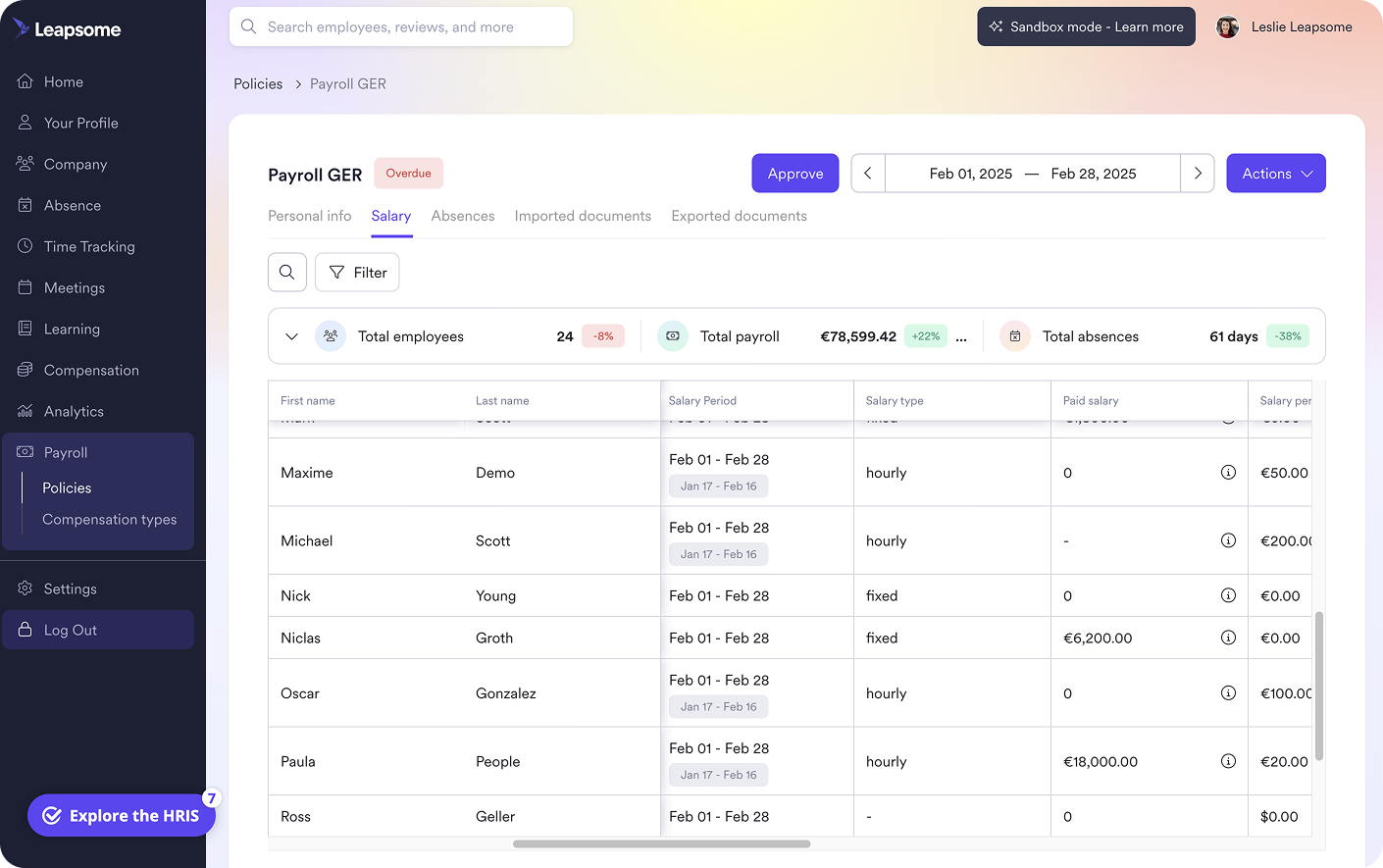
Scaling companies need a payroll compliance setup that can adapt to these (and other) local rules. Leapsome helps by keeping people data structured across locations, and flagging inconsistencies before they become payroll mistakes.
🌍 Stay compliant across the globe
Leapsome’s Payroll Prep helps HR prepare accurate payroll data with less manual work, thanks to built-in support for local rules, labor laws, and GDPR-compliant processes.
👉 Explore Payroll Preparation
Common consequences of non-compliance
When non-compliance plagues your organization, you’ll need to worry about:
- Back pay and liquidated damages: Employers may need to repay missed wages, unpaid overtime, or incorrect final checks. Under the FLSA, minimum wage and overtime violations can also lead to liquidated damages equal to the unpaid amount.
- Tax penalties and audits: The Wage and Hour Division reports that in fiscal year 2025, there were nearly 17,000 compliance actions and about $59 million in civil money penalties assessed. Late depositions, incorrect withholdings, and missed filings can trigger interest and government reviews.
- Legal and reputational risks: Noncompliance can expose the company to legal claims, and damage its reputation as an employer.
Common compliance mistakes and payroll best practices
“If your HR systems don’t really talk to each other…You kind of have to pull this from your HRIS, this from your performance review, this from payroll…I think the trails break down a little bit.”
– Sammie Masley, Senior People Ops Manager at Leapsome
Let's look at some of the mistakes that can lead to negative payroll outcomes, and how to avoid them:
- Missing payroll tax deadlines: When your payroll calendar is disconnected from employee and pay data, HR may know the deadline but lack the information needed to meet it. Best practice: Keep payroll deadlines, owners, and required inputs in one shared workflow, so HR can confirm what’s ready before the cutoff.
- Failing to track legislative updates: If legal updates live outside the HR system, teams may keep applying outdated wage, tax, or leave rules without realizing it. Best practice: Use an HRIS that can track location-specific rules and flag inconsistencies.
- Misclassifying employees and independent contractors: Deel reports that up to 30% of employers have misclassified at least one worker. This risk grows when employee data and approval records don’t live in the same system. Best practice: Keep worker status, role details, compensation data, and approvals in one system, so HR and finance can trace every payroll input.
If you don’t have a system that can handle all the above tasks, don’t worry. Leapsome brings together payroll and employee data, so everything you need to maintain compliance lives in one place.
“Using those automation workflows and having all the data in the right place really gives you time back to do that important strategic HR work. The goal is to keep reducing those manual touch points.”
– Sammie Masley, Senior People Ops Manager at Leapsome
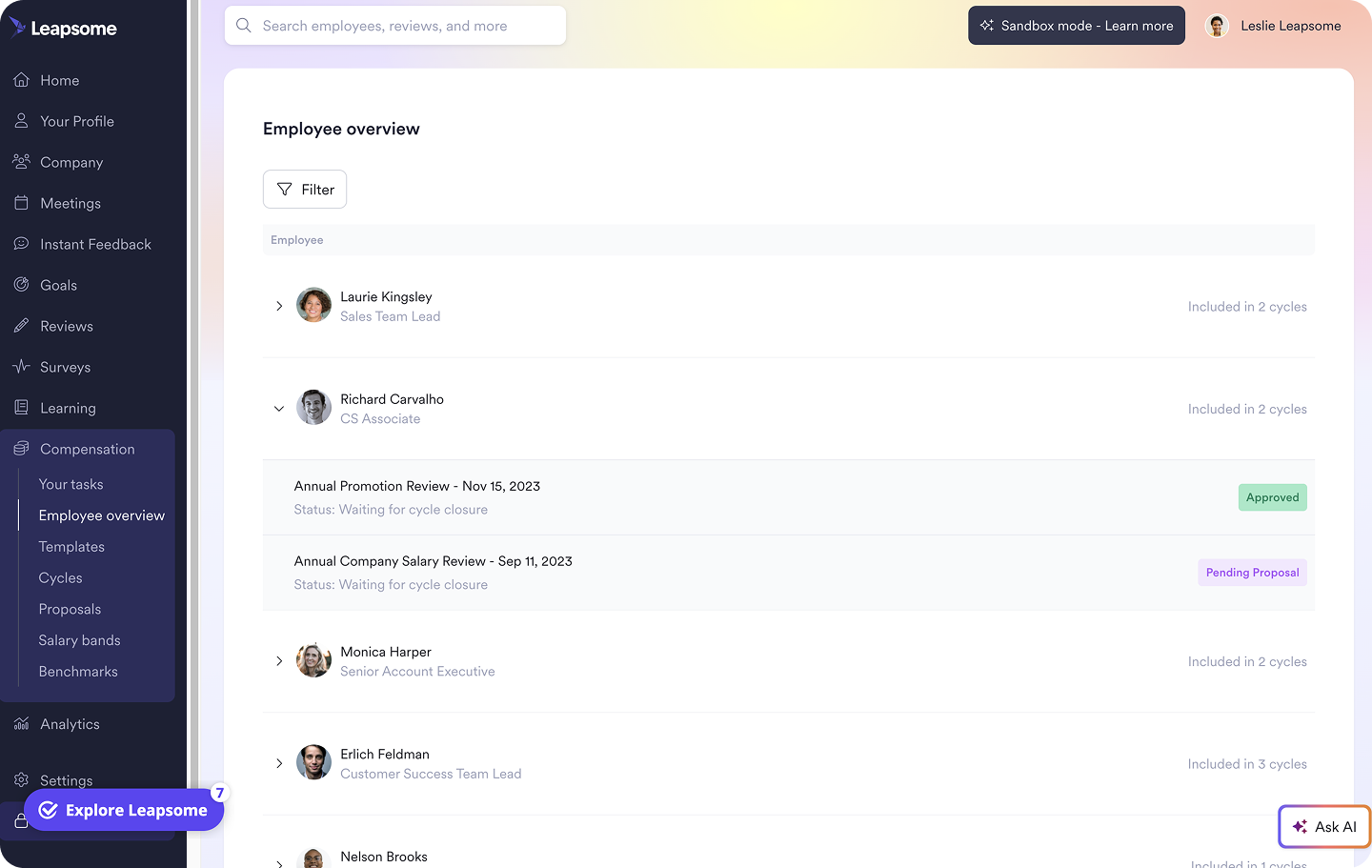
📌 Pin down worker status before payroll
Leapsome’s Compensation Management centralizes pay data and approvals, helping HR and finance spot inconsistencies that could create payroll or misclassification risks.
👉 Explore Compensation Management
Payroll compliance checklist: Build a safer process
“Teams that are ready don’t just prepare before the audit, they prepare their day-to-day work… where they don’t have to do the preparation when it comes.”
– Erica Ancobia, CEO and Managing Director at KUNO
Companies that get payroll right don’t depend on last-minute checks. They build centralized infrastructure around payroll inputs, so accuracy becomes part of the process. That can be a lot of work, but you don’t have to start from scratch.
💸 A payroll compliance checklist for mature organizations
Use our checklist to see where payroll compliance risk enters your workflows, and identify which gaps HR should fix first
👉 Download the checklist now
Build payroll compliance into your people strategy with Leapsome
You already know payroll compliance relies on accurate records and clear approvals. The problem is that knowing the requirements isn’t enough to build a system that keeps every payroll run accurate and ready for review.
But you don’t have to build your own system. With Leapsome’s all-in-one HRIS and people management platform, payroll compliance becomes a managed, auditable process built right into the employee lifecycle.
With Leapsome, HR teams can:
- Keep employee records payroll-ready: Store worker statuses, locations, contact details, and role data.
- Connect pay and absence changes: Bring compensation updates and absence data into the same system before payroll prep begins.
- Prepare cleaner payroll inputs: Turn approved people data into accurate, compliant payroll inputs that can sync with software solutions like ADP.
- Support local compliance requirements: Configure payroll rules, tax structures, and allowances by location.
- Create a clearer audit trail: Keep the records and approvals behind payroll changes in one place, so HR and finance can explain what changed and why.
“Employees can now find everything in one place — their data, absences, goals, and reviews. I don’t have to explain which tool to use for what. It’s all in Leapsome.” – Merilyn L, Senior People Operations Specialist at Bob W.
✍ Make compliance the default with cleaner payroll prep
Leapsome’s connected HRIS brings employee and pay data together, so compliance payroll inputs can sync with your payroll software.
👉 Request a demo
Disclaimer: This content is for general informational purposes only and does not constitute legal advice. Leapsome does not guarantee legal compliance and cannot confirm how specific situations would be assessed in court. If you're unsure how the requirements apply to your organization, please consult qualified legal counsel.