Payroll journal entries: Prepare for a clean monthly close, every time


Growth has a way of exposing ugly payroll problems. Perhaps you’ve already noticed that some of your early payroll processes can’t keep pace with the demands of an expanding team.
If so, you’re not alone. Data from Alight shows just how common this issue is, with 53% of respondents saying they faced payroll-related penalties for non-compliance in the past five years.* It’s no coincidence that 51% of surveyed companies still rely on spreadsheets for their payroll operations, while 19% use paper and other manual methods.
That’s a real concern, because payroll journal entries are a crucial meeting point between HR and finance. Let’s explore how to create consistency and avoid constant month-end meltdowns.
* Alight, 2024
What’s a payroll journal entry?
Payroll journal entries are the official financial records of what happened during each payroll cycle. Whenever an employee gets paid, that transaction data flows to your company’s accounting system for payroll, so finance can accurately track labor costs and cash flow.
The exact format of a journal entry can vary, but it must include a few core components:
- Gross wages and employer payroll taxes: This information captures the true cost of payroll, showing the total amount earned by employees before deductions plus each person’s share of taxes.
- Withholdings and deductions: In this category, you’ll find any amounts withheld from an employee’s pay, such as deductions for retirement contributions and other benefits.
- Net pay: Unlike gross wages, net pay is what employees receive after all taxes and deductions are taken out.
Why payroll journey entries are more than just paperwork
Logging payroll can seem like a rote bookkeeping exercise, especially when you’re focused on scaling. But payroll journal entries can actually support growth, through better:
- Financial transparency: Consistent entries keep your finance team in the know about labor costs, so they can spot unexpected variances.
- Workforce planning: Since payroll is one of your largest expenses, accurate journal entries have a cost-saving function. HR and finance alike can use them to watch compensation trends and make confident budgeting decisions.
- Audit readiness: Comprehensive payroll docs create a defensible paperwork trail you can use to support compliance and quickly resolve questions from regulators.
“Teams that are ready don’t just prepare before the audit, they prepare their day-to-day work… where they don’t have to do the preparation when it comes.”
– Erica Ancobia, CEO at KUNO
Three types of payroll journal entries
Although the way you organize payroll journal entries depends on the time and purpose for each payment, documentation usually fits into one of three broad categories.
1. Standard payroll journal entries
Think of these as your baseline payroll records. They capture what actually happened during a regular payroll run, and include details about employee earnings and deductions.
2. Accrued payroll journal entries
“If we have someone leaving, and then maybe they receive a later bonus payment, that’s something that needs to be flagged because that payment is going to be booked in a completely different way.”
– Sammie Masley, People and Talent Partner at Leapsome
Sometimes, you incur payroll expenses before employees actually get paid. In these cases, finance must record accrued payroll expenses to make sure statements reflect labor costs in the correct accounting periods. Once payroll is processed, however, these entries reverse.
3. Manual payroll journal entries
There’s no perfect system, so there will always be cases when you have to step in to correct errors or handle one-offs. That could mean issuing a check for a forgotten bonus, or processing an unexpected termination payout.
How to process payroll journal entries accurately
Entering accurate payroll journal entries might seem intimidating if your teams are large. But the process is straightforward enough when you break it down:
- Gather and verify payroll data: Don’t discount the significance of data collection for each pay period. Although this may seem like an elementary admin step, discrepancies like unrecorded absences or missed promotions are common reasons for mistakes.
- Calculate gross pay, taxes, and deductions: Using the data on gross wages, payroll taxes, benefits, and deductions, math out what employees earned and what should be withheld.
- Write the journal entry: It’s time to translate payroll activity into financial records, by recording it in your accounting system. To simplify this step, create a reusable template.
- Disburse net pay and remit liabilities: Pay employees their net wages, while sending taxes and deductions to appropriate authorities.
- Review and reconcile everything: Before closing the books, compare payroll reports against your journal entries, general ledger, and bank transactions. Pay special attention to common discrepancies that need immediate attention, like duplicate entries or incorrect tax calculations.
Data from KPMG shows that, although 92% of organizations have global payroll strategies, just 25% reported that their current vendor management frameworks were effective. If you’re also investing in payroll, but still running into errors as you scale, you may be looking for the solution in the wrong place.
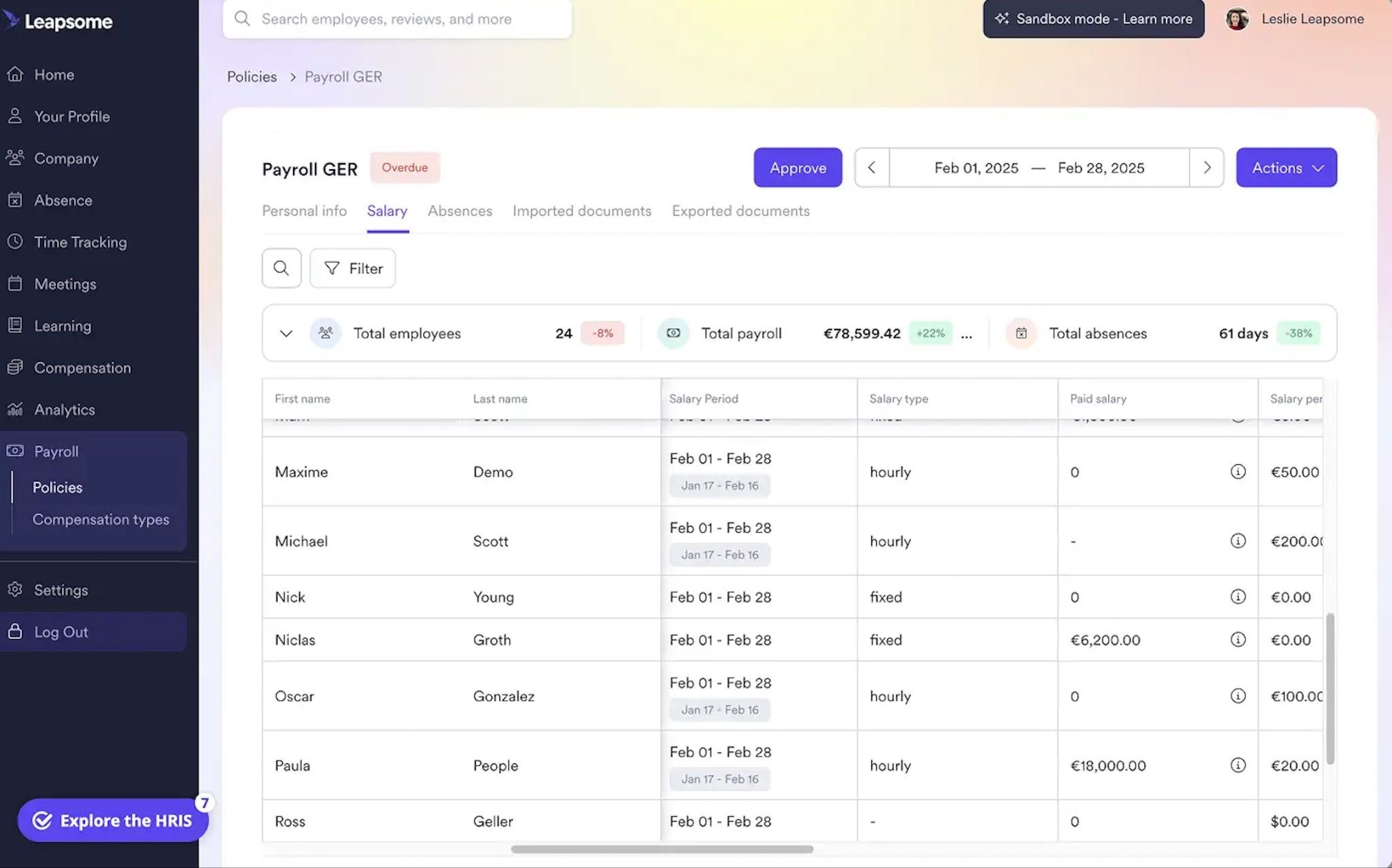
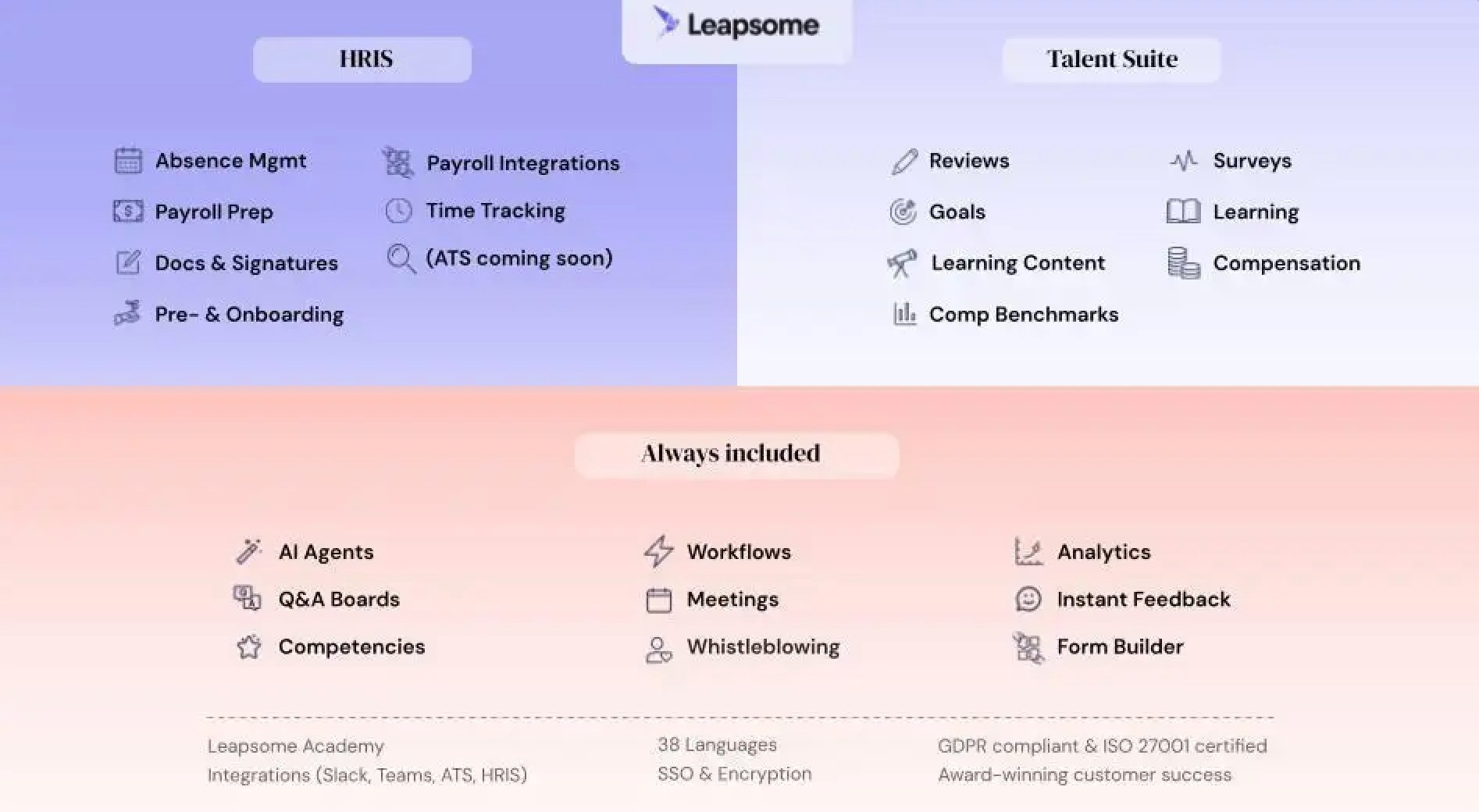
Although Leapsome’s HRIS and people management platform doesn’t process payroll directly, it helps with the entire reporting process by centralizing your employee data and linking directly to payroll partners. And with Leapsome’s payroll prep tools, HR can keep compensation records and documents up to date at all times.
“On the C-level, I learned to doubt people data because it arrived late and conflicted across files. Then, sitting in HR, I felt the pain from the inside and saw how much time went into rebuilding the same reports. Centralizing restores trust and your calendar.”
– Florian Klages, Managing Partner at torq.partners
🧾Clean up your journal entries
Leapsome’s Payroll Prep tools capture all your workforce changes in real time, so HR never has to scramble to submit accurate data.
👉 Learn about Payroll Prep
Best practices for useful payroll journal entries
When payroll journal entries run smoothly, it’s because HR has a few successful habits in place:
- Document every entry and adjustment: Never assume a transaction is too small to include in your reports. You’ll need comprehensive entries to trace any variances, and give finance leaders the confidence that every number has an explanation.
- Stay current on tax rates and regulations: Payroll tax and compliance rules change often, so set up a regular review with legal counsel.
- Reconcile the payroll ledger monthly: Hold monthly reconciliation meetings to go over payroll reports, journal entries, and the general ledger.
Transitioning from manual to automated approvals is another way to make payroll journal entries less stressful. Leapsome’s Workflows take admin tasks off your HR team’s plate, while keeping critical data like PTO and compensation in one place.
🔗Close the gap between employee changes and payroll entries
With Leapsome’s automated approvals, every change ends up in your payroll prep before the data heads off for processing.
👉 Explore Workflows
Payroll readiness checklist for HR and finance
To make sure all the data HR ships is up to date and free from inconsistencies, routinely ask these pre-payroll verification questions.
Employee data readiness
- Are all salary and rate changes approved and applied for this pay period?
- Have we updated department, cost center, location, and employment type assignments for every employee?
- Did we update all manager changes that affect approval flows?
Variable pay and input readiness
- Have we submitted, approved, and documented all bonuses, commissions, and retroactive pay?
- Are all overtime hours, absences, and leave adjustments confirmed and closed?
- Did we account for all reimbursements and one-time payments with a clear approval trail?
HR-finance alignment
- Is there agreement with finance on the payroll cost breakdown by department or cost center?
- Did we confirm whether bonus and commission classifications should be recorded as expenses or liabilities?
- Have we delivered the payroll summary to finance in the agreed format and before the cutoff?
✅ Get a payroll preparation checklist
Use this list of questions to evaluate HR’s data readiness before payroll runs.
👉 Download the checklist now
Manage payroll data smoothly and accurately with Leapsome
If your payroll processes feel off-kilter, don’t immediately point your finger at finance. After all, it’s HR that handles the employee data flows needed to submit payroll and write accurate journal entries.
Deloitte data shows that 84% of organizations use 20+ payroll system integrations. With such a complex web of protocols, is it any surprise how many companies experience migraine-inducing month-ends?
Leapsome’s centralized HRIS and people management platform helps you clean up payroll data to cut your risk of errors, with:
- Automated flows: Every change syncs to payroll prep, without the need for manual re-entry.
- Absence and time tracking: Keep all your approved leave data in an integrated HRIS, so expenses in journal entries match actual workforce activity.
- Automated approval workflows: Automatically finalize compensation and HR changes long before they impact payroll.
“Employees can now find everything in one place — their data, absences, goals, and reviews. I don’t have to explain which tool to use for what. It’s all in Leapsome.” – Merilyn L, Senior People Operations Specialist at Bob W.
💵Turn data cleanup into payroll confidence
Make sure all the employee data that feeds payroll reflects the latest reality, using Leapsome’s centralized HRIS and people management solution.
👉 Request a demo