Four best diversity and inclusion hiring practices for a fairer recruitment process


Diversity and inclusion hiring removes hidden biases that exclude qualified candidates and instead assesses applicants against consistent, job-relevant criteria. Most HR teams are familiar with the principle, but some struggle to get recruiters and hiring managers to apply it consistently.
A study by Harvard Business School and the Burning Glass Institute found that 45% of companies removed degree requirements from job postings without meaningfully changing whom they hired.* This shows that removing boundaries in theory doesn’t eliminate bias in practice if managers keep using outdated filters.
The best diversity and inclusion hiring practices build fairness into each decision, with clear requirements and consistent evaluation criteria. This guide explains how, covers common mistakes, and offers a stress test to help you identify where your hiring process might let bias steer decisions.
* Harvard Business School and Burning Glass Institute, 2024
What’s diversity and inclusion hiring, and why does it matter?
“Psychological safety is allowing people to experience the human mess without it being to their detriment in their job. It’s letting people show up fully in their identity, regardless of who it offends.”
— Madison Butler, Founder at Permission Slip Labs
Diversity, equity, and inclusion (DEI) hiring encourages organizations to recruit and evaluate people based on what they can do, regardless of characteristics such as race or gender. It asks teams to remove barriers that block qualified applicants and to design a process that works for a wide range of candidates. When the process is accessible and grounded in job-relevant skills, managers make clearer and more consistent decisions.
Diversity hiring brings a mix of identities and perspectives into the workforce. Inclusion ensures all people can participate and receive fair treatment. When these principles guide hiring, teams build a stronger foundation for development and advancement.
A thoughtful diversity and inclusion recruitment strategy helps you:
- Reach more qualified candidates: Removing barriers in your recruitment process gives more people a chance to apply and create a more diverse workforce.
- Reduce inconsistent decisions: Clear scoring criteria help managers assess candidates on the same basis.
- Strengthen the candidate experience: Explaining the interview format and making adjustments to requests helps candidates prepare and participate.
- Support inclusion after hiring: Passing agreed adjustments to the person responsible for onboarding helps new hires start with the support they need.
Four DEI hiring best practices
“Be curious. You never know what you’ll learn about someone’s culture or way of communicating. Curiosity creates special moments of understanding.”
— Tiffany Tara Anderjaska, People, Talent & Efficiency Interim Lead at Tiffany Tara Consulting
Effective DEI hiring practices give managers clear instructions at each selection stage. HR should establish the standards and make sure every recruiter knows how to apply them. Here are four best DEI hiring practices.
1. Write inclusive, skills-focused job descriptions</h3>
Before publishing a vacancy, ask the hiring manager to connect each requirement to a task the person will perform. If they request five years of experience, have them explain what someone must have learned during that time. Use that answer to describe the skill candidates need to demonstrate.
Separate essential qualifications from skills someone can learn after joining. A specific software requirement could exclude an experienced applicant who uses a comparable tool and could learn yours during onboarding.
Review the language for assumptions about who should apply:
- Replace coded words like “digital native,” which can suggest an age preference, with the software skills the role requires.
- Describe working arrangements precisely. If flexible hours are available, explain the core hours employees must cover.
- Include a named contact or clear route for requesting reasonable accommodations and application adjustments.
2. Make candidate screening more consistent
Create a short screening scorecard before reviewers see applications. For each essential skill, specify what evidence would justify moving the candidate forward. Then have reviewers independently assess the same small sample of resumes.
Compare their scores and resolve differences before they screen the remaining candidates. This gives HR a practical way to catch conflicting standards early.
Bias often starts during screening. In an experiment involving more than 83,000 people, applications with distinctively Black names had a 2.1-percentage-point lower probability of employer contact than those with distinctively white names.
To make the screening process more DEI-friendly, you can:
- Limit identity cues: Remove names and photographs during initial screening to limit the affinity bias.
- Create consistent evaluation rules: Standardize rubrics for assessing career gaps and unfamiliar employers against the agreed criteria.
- Require clear justification: Require a brief, job-related reason for each rejection.
3. Use structured and accessible interviews
Give your interviewers a shared set of questions, with scoring guidance that describes what a strong answer demonstrates. Allow follow-up questions to clarify evidence.
Ask each interviewer to submit their scores and supporting notes before the interview panel discusses candidates, so the first person to speak doesn’t shape the opinion of others.
Help candidates prepare and participate by making the structured interview process clear:
- Share the format and expected duration in advance.
- Give candidates an easy way to request adjustments, and assign someone to arrange them before the interview.
- Check that video tools support captions and assessment materials work with screen readers.
- Allow preparation time for tasks when immediate responses aren’t a requirement of the job.
4. Measure outcomes and improve the process
Review where candidates move forward or leave the hiring process to spot which inclusive recruitment practices need your attention. Start with a few focused checks instead of looking at overall hiring numbers:
- When you collect voluntary demographic data, compare progression rates at each stage for similar roles.
- If candidates with disabilities repeatedly leave before an assessment, check its accessibility and how you handle adjustment requests.
- With optional feedback forms, look for recurring concerns and reasons for declining job offers.
Once you audit the data, assign someone to make each agreed improvement, then check the results in the next hiring round. Use unconscious bias training to address specific problems you uncover.
If you want to make your DEI strategy easier to track and improve, rely on a centralized platform like Leapsome to review candidate progression alongside the assessment behind each decision.
“Look for one platform that covers your key needs and integrates with your stack. Don’t scatter data across 10 or 20 disconnected tools.” — Katerina Arsova, Head of People & Talent Operations & Partnerships, Leapsome (at the time)
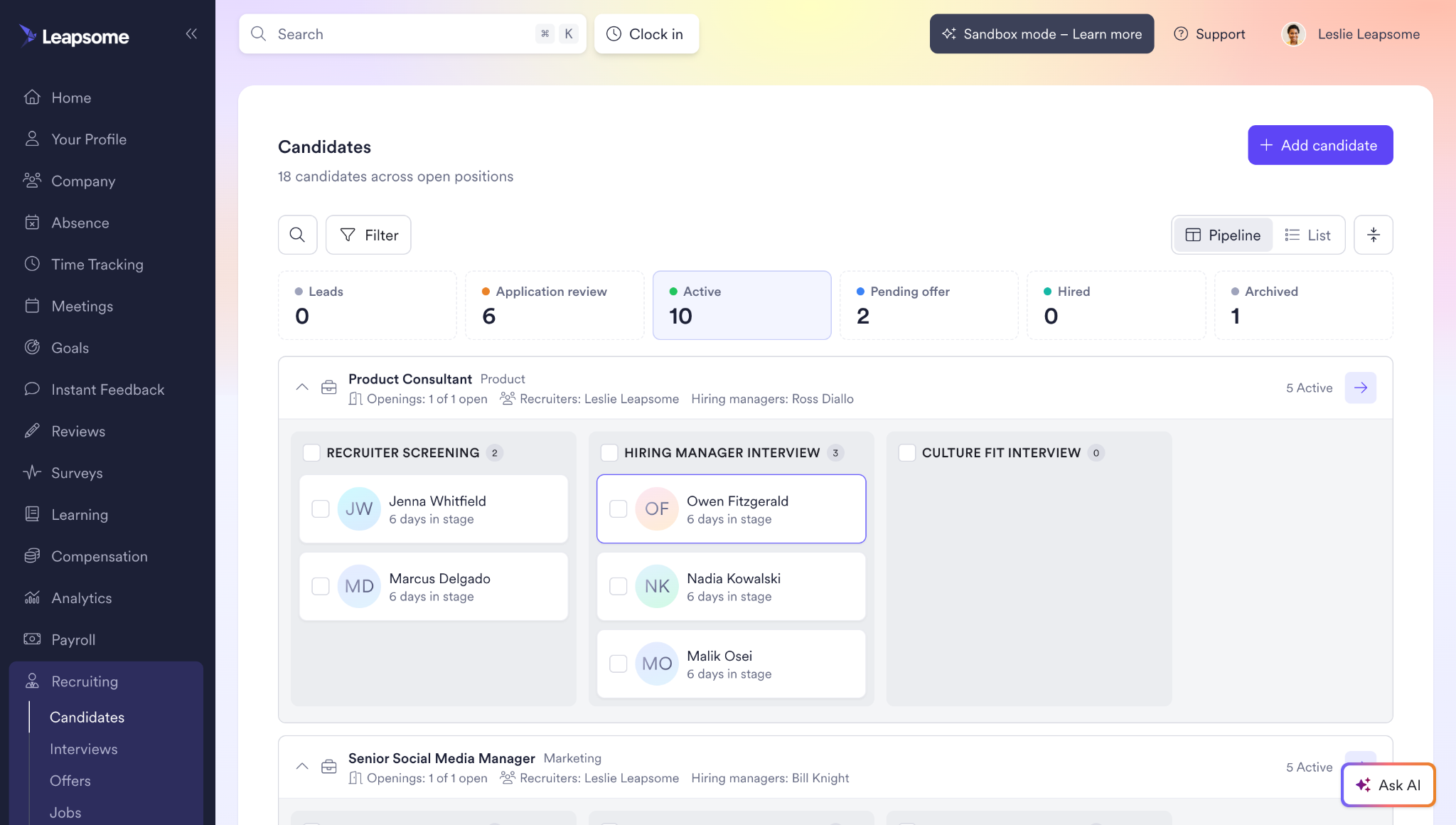
⚖️ Make fair evaluation part of every hire
Leapsome Recruitment gives interviewers shared questions and scorecards, so candidates receive consistent assessment across hiring managers.
👉 Explore Recruitment
The inclusive hiring stress test: Where can bias enter your recruitment process?
“This work can’t just be HR’s problem. It has to be built into your business foundation — into your policies, your processes, your management training.” — Madison Butler, Founder at Permission Slip Labs
Your DEI hiring process should hold up when a manager rushes to fill a vacancy, and HR has no time to review every decision. Because bias training alone gives you too little control over what happens in those moments, it’s better to use the checks below to review each stage of your hiring process:
- Role definition: Unnecessary requirements can exclude qualified applicants. Ask the hiring manager to connect each essential requirement to the work the potential new hire will perform. Also check how often reviewers reject candidates for missing a qualification listed as optional.
- Screening: Reviewers may apply different standards to similar experiences. One reviewer may accept relevant volunteer experience while another counts only paid work. Everyone needs to agree on what evidence meets each requirement, then have the reviewers assess the same sample of applications to see if there are disagreements.
- Structured interview and selection: Personal impressions often outweigh evidence of ability. To avoid favoring people who resemble the existing team based on a good “culture fit,” use a list of specific skills and behaviors that recruiters need to assess.
Define what success in the role looks like before posting the job, then carry those expectations into onboarding and development. A connected platform like Leapsome helps teams use the same core competencies throughout the employee lifecycle.
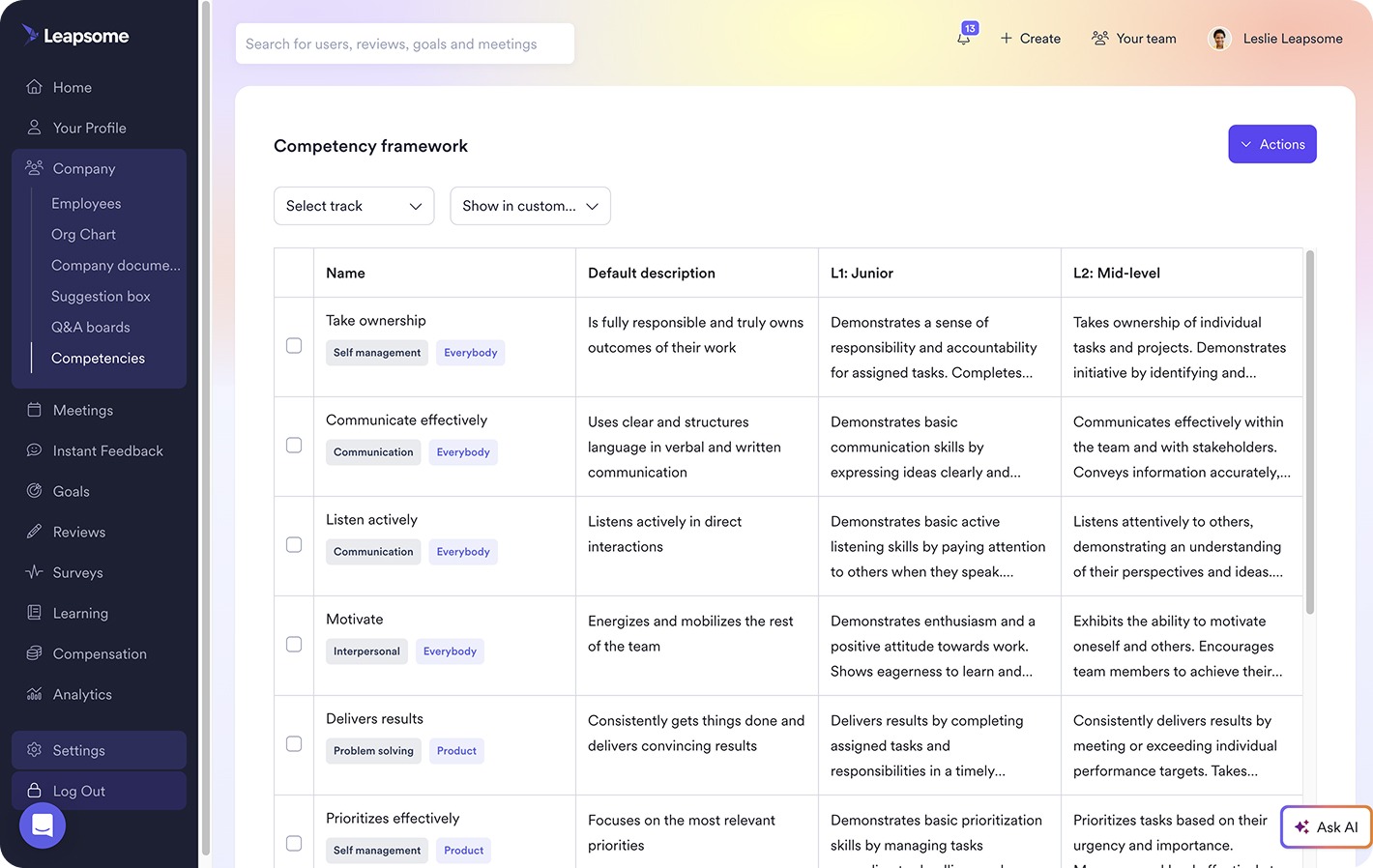
🔭 Give managers a shared standard for assessing talent
Leapsome Competencies helps you define job-relevant skills and behaviors, so personal preferences have less room to shape evaluations.
👉 Explore Competencies
Build inclusive hiring processes that managers can follow with Leapsome
A lean HR team can set clear DEI hiring standards but still spend hours chasing interview feedback or reminding managers to use them. As hiring volume grows, those manual checks become harder to maintain.
While technology alone can’t make hiring inclusive, it can help your team apply a thoughtfully designed process consistently and spot where it needs to improve. Tools that centralize workflows give HR a clearer view of how candidates move through each stage and where decisions drift from agreed criteria. Leapsome is an AI-powered HR platform that connects recruiting, onboarding, performance, and engagement in one system. With it, teams can carry structured expectations forward after the hire.
With Leapsome, HR can set the standards and managers can carry agreed expectations forward through:
- Recruiting: Give hiring teams structured screening criteria and interview scorecards to assess candidates against the role’s requirements.
- Competencies: Define shared skills and behaviors that managers can use during selection and revisit in performance reviews.
- Preboarding and Onboarding: Assign preparation tasks so new hires receive the information and support they need to start.
- Engagement Surveys: Gather employee feedback to understand if people experience fair treatment and access to development opportunities after joining.
“Leapsome is very helpful to streamline processes and focus on employee engagement. It provides structure to everyone, and most importantly, it fosters a feedback and development culture. That is exactly what we’re aiming for — for everyone to be able to openly provide feedback and develop best within their role.” — Jaqueline Weinert, People Manager | Oetker Digital
🌱 Make fair hiring a practice your team can sustain
Leapsome connects candidate evaluation with ongoing employee support, helping managers apply your inclusive workplace commitments throughout the employee lifecycle.
👉 Request a demo
FAQ
What common mistakes should you avoid in inclusive hiring?
To ensure inclusive and diverse hiring practices, avoid relying on personal assumptions or limiting recruitment to familiar talent pools. Other common mistakes include overlooking underrepresented groups, ignoring accessibility needs, and treating unconscious bias training as a substitute for consistent, job-relevant selection criteria.