Nine best AI tools for HR teams, and tips for choosing the right one


Although 77% of HR leaders are planning to ramp up AI usage,* identifying which tools and use cases add value can feel daunting.
As part of an intentional HR strategy, the right AI-powered tools create meaningful capacity and improve human decisions. But for AI tools to be effective in practice, HR teams need to address the risks of tool spread and data insecurity.
Here we’ll cover AI tools for HR that have the potential to cut routine tasks and enable strategic people work — without resulting in unnecessary risks and complexity.
*Paylocity, 2026
What are HR AI tools, and how can your team use them?
AI HR tools are software that use artificial intelligence to improve the speed and quality of HR work. They’re designed to improve outcomes across the employee lifecycle by automating tasks and capturing and analyzing people data. AI systems touch almost every area of human resources, including:
- Recruiting and hiring
- Employee engagement and support
- HR operations and automation
- Performance management
- People analytics and workforce planning
Unlike general-purpose artificial intelligence, AI HR software has department-specific features, such as resume screening and personalized learning paths. Typically, these tools also plug into HRIS ecosystems and provide compliance guardrails.
Keep in mind that not all AI HR platforms were built specifically for human resources. Tools like ChatGPT and Zapier have broad uses but can still deliver value to HR teams.
While AI-powered tools can directly reduce HR workloads, they also have the indirect advantage of freeing up time. With less on their plates, HR teams can devote effort to human-first initiatives like building company culture and nurturing career development.
“Being armed with the power of memory and language doesn’t mean you have the power of wisdom, and wisdom is the make-or-break piece. Wisdom is the human component forever. Every system that looks automated still reflects human decisions about how it should operate.”
– Cassie Kozyrkov, CEO at Kozyr; Former Chief Decision Scientist at Google
What should you look for when choosing HR AI tools?
It’s easy to get caught up browsing AI capabilities. But the truth is that AI in human resources is most valuable when it focuses on outcomes, not a long checklist of features.
Further, choosing AI tools should involve the larger company, since people data, performance, and security are often defined at the organizational level. Be sure to loop in stakeholders across your company to ensure AI-powered features fit your tech stack and business goals.
Here’s how to figure out which functions fit your needs:
- Start with the problem and expected value: Identify which core HR tasks involve high-friction, repeatable work or where AI has the potential to make quality improvements. For instance, updating employee data across systems is time-consuming and error-prone, so it fits both criteria.
- Assess privacy, security, and human oversight: Managing and auditing AI results can be time-consuming, especially in a compliance-heavy field like HR. Consider the level of oversight each tool requires and the privacy and security safeguards it has in place.
- Evaluate context and integration: Delve into which employee data it manages and what platforms it connects to. The best artificial intelligence in HR integrates with your greater HRIS, data streams, and workflows to create unified operations.
Connected data is the foundation for smooth, accurate workflows, and platforms like Leapsome keep employee context in sync. Bring all your data together, from personal information and role details to compensation and job history.
“Without a single, reliable data set, AI is just a buzzword. Put your people data in one place, keep it accurate, and only then will AI deliver value on top.”
– Florian Klages, Managing Partner at torq.partners
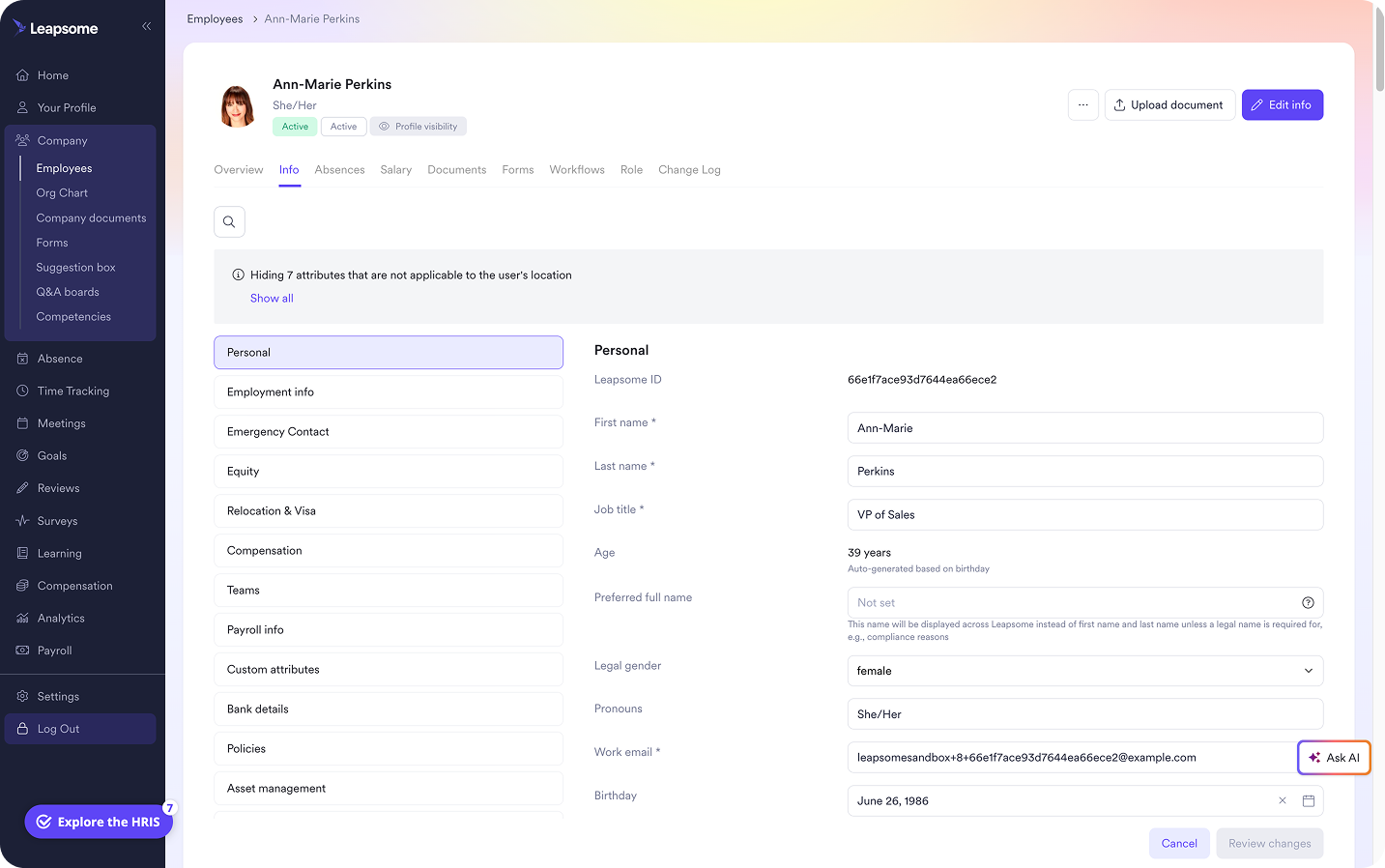
🗂️ Clean up the employee data that powers AI
A strong data foundation helps your HR AI tools generate accurate, reliable recommendations. Leapsome centralizes your employee data for up-to-date and connected HR workflows that better inform your people insights.
👉 Set up Employee Records
Leading AI tools for HR teams
“Look for one platform that covers your key needs and integrates with your stack. Don’t scatter data across 10 or 20 disconnected tools.” – Katerina Arsova, Head of People, Talent Operations, and Partnerships at Leapsome
Here we’ll look at top HR tools that go beyond entry-level AI use and center human judgment on your HR team.
AI tools for employee engagement and performance
Designing the employee experience is often a matter of human-first strategy, but AI for HR can help with analysis and personalization.
For example, AI can evaluate surveys, feedback, and workplace sentiment, as well as provide predictive metrics on employee burnout or retention. AI-backed goal setting and career path design can also give every professional custom, ongoing support.
Here are a few platforms that fit these applications.
1. Leapsome
Leapsome’s all-in-one HRIS and people management platform helps lean HR teams analyze employee feedback and support managers through performance reviews. Various AI tools can summarize survey comments, suggest follow-up actions, and draft reviews based on goals and recorded feedback.
These features are natively integrated into Leapsome’s other HR systems, reducing the need to move employee information between tools manually. And since Leapsome’s AI respects existing access permissions, each team member can only work with employee data they’re authorized to use.
2. Lattice
With Lattice, HR teams can turn engagement survey results into clear priorities. This tool’s AI summarizes employee comments, then recommends actions based on key engagement drivers.
Managers can also create team-specific action plans within Lattice, which makes it useful for organizations that struggle to follow through on employee feedback. Teams can also import historical engagement survey results to preserve context when moving from another platform.
3. Culture Amp
Culture Amp combines AI survey analysis with manager coaching grounded in people science research. Some AI tools summarize employee comments and identify sentiment, while the AI Coach guides managers through interpreting results and planning responses.
Managers can also use Culture Amp to practice difficult conversations through guided role-play, before they speak with employees. This platform might suit organizations where managers need more support turning employee feedback into action.
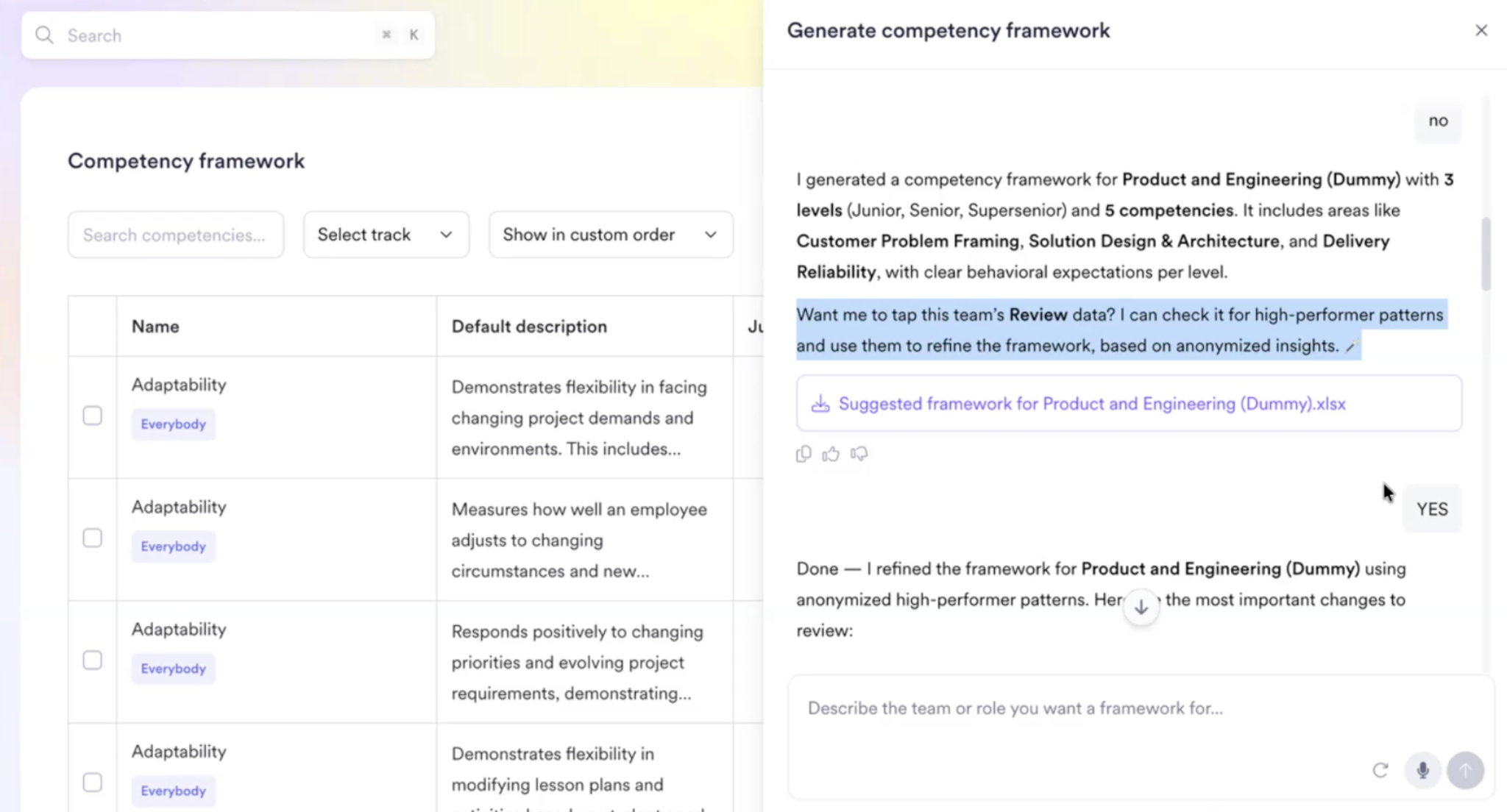
👤 Add an AI member to your lean HR team
Leapsome’s AI Agents support your team in surfacing insights related to surveys, feedback, and culture trends, letting you turn raw data into real next steps.
👉 Implement AI Agents
AI tools for recruiting and talent acquisition
AI HR and recruitment tools are aimed at reducing admin work when managing candidates. These platforms often automate talent outreach, resume screening, and candidate follow-up.
Here are a few AI tools for HR professionals that stand out in this category.
4. Paradox
Paradox aims to reduce delays in high-volume hiring through its conversational AI assistant, Olivia. Candidates answer screening questions through chat or text, and qualified applicants can move directly to interview scheduling.
Olivia also handles rescheduling and sends reminders, reducing the coordination recruiters have to manage manually. The focus on mobile conversations makes Paradox most useful for front-line hiring, when recruiters need to respond quickly across multiple locations.
5. Eightfold AI
The Eightfold AI platform can match candidates to roles based on skills and experience, including applicants already in the company’s talent database. Thanks to a focus on transferable skills, this tool can surface suitable people whose job titles don’t suggest an obvious match.
Eightfold AI tends to suit recruiting teams that manage large talent pools, and that struggle to find relevant candidates within existing records. It also has a fairly broad scope, helping with tasks outside of hiring like employee development and resource management.
6. Hirevue
Hirevue can support consistent candidate assessments through structured interviews and AI scoring against job-related competencies. AI features analyze candidates’ answers and give recruiters a common basis for fair comparison.
For AI-scored video assessments, Hirevue evaluates transcripts without scoring facial expressions or tone of voice. This platform may be best for enterprise teams assessing large applicant groups, and that need plenty of structured evidence before deciding who progresses to live interviews.
AI tools for HR productivity and automation
“Our managers hate review time. I built a GPT that turned a three-minute voice memo into a full review draft — their time was cut in half.”
– Melanie Naranjo, Chief People Officer at Ethena
HR AI tools for automation complete routine tasks for you, from handling leave requests to drafting job descriptions. They may also include self-service AI chatbots, which reduce admin when employees want to check benefits, personal data, and company policies.
Here are a few of the best AI tools for HR teams that want to save time.
7. ChatGPT
Teams can use ChatGPT to speed up drafting, especially when they already spend too much time creating routine content. This AI platform can turn role requirements into job descriptions, or adapt approved policies into clear employee communications.
ChatGPT’s flexible, conversational format might suit teams that need writing support across different tasks. HR should still provide context and check each draft for accuracy.
8. Microsoft Copilot
Microsoft Copilot brings AI writing support into Microsoft 365, which can reduce the time teams spend drafting HR communications. Teams can also configure employee self-service agents through Copilot Studio to answer policy questions and support leave requests.
These agents can escalate complex or sensitive requests to HR specialists for personal support. Native integrations with other Microsoft software could also make this platform worth considering for organizations already using those tools.
9. Zapier
Zapier can connect applications to reduce manual handoffs between HR systems. This tool allows you to build workflows that use AI to summarize employee requests, then route them to the right people.
A new-hire record can also trigger onboarding tasks and notifications across connected applications. Overall, Zapier’s main strength is its ability to combine AI with actions across different tools, making it useful when HR needs to integrate an existing tech stack.
Where should HR actually use AI? Value vs. risk framework
Just because it’s technically possible to automate an HR process doesn’t mean it’s the right choice. Decisions in HR have real impacts on people’s careers, and AI use cases should be carefully evaluated within this human-first context.
According to The World Economic Forum, HR pros using AI tools tend to fall into two categories: those who accept AI suggestions without question and those who distrust and fear AI systems. The right path isn’t either of those directions. Future HR teams need AI tools that automate tedious work and the confidence to know when to exercise human judgment.
SHRM agrees that AI is a tool to make human work stronger, so it needs a human team to review and validate every result. AI processes data at a scale people can’t, but humans add factors AI can’t manage: Compassion, context, and understanding.
To pinpoint where to use AI for HR, weigh the risks and the level of human oversight required to monitor it. While saving time in HR is an important goal, it can’t come at the expense of leaked employee data or errors that reduce brand reputation.
“We need to be careful what data we feed into AI tools. If we share sensitive or personal information without permission, we risk serious ethical and legal consequences.”
– Jonathan Passmore, SVP at Ezra (Adecco Group); Professor of Coaching and Behavioral Change at Henley Business School
Here’s a simple framework to help your HR team evaluate the potential value versus risk level of AI tools:
- High value, lower risk AI: Communications, such as summarizing survey comments, drafting HR handbooks, and providing a self-service chatbot
- High value, higher risk AI: People decisions, such as resume screening, performance monitoring, and predictive workforce analytics
- Lower value, lower risk AI: Basic administration, including formatting documents, scheduling meetings, and drafting emails
- Lower value, higher risk AI: People decisions with minimal business benefit, such as video interview analysis and automated performance scoring
The best HR AI tool isn’t the one that can do the most. It’s the one you trust to improve work on your HR team — without putting your people decisions, data privacy, or tool efficiency at risk.
Why more AI tools doesn’t always mean better HR outcomes
When not used carefully, AI in HR can save time on one task while adding work to the processes around it. For a lean HR team, every new AI adoption should start with a review of the tools the company already pays for.
It’s easy to overlook capabilities in your existing platforms and opt for standalone products to solve the same problem. SHRM’s reporting on HR software sprawl highlights how these overlapping investments increase costs, and leave organizations with disjointed systems that deliver little business value.
For example, one HR team might adopt an AI survey analysis tool, although its current HRIS offers sentiment analysis and recommended actions. The company pays twice for a capability it already has, and it splits employee feedback across two platforms. HR must keep that data in sync, adding more manual work or resulting in incomplete data (or both).
So before approving another AI tool for HR management, go deeper to establish:
- What your current platforms enable: Test relevant AI-assisted features against a real task. A capability might simply require configuration or training, rather than a completely new platform.
- What the additional cost buys: A specialist AI tool should close a specific gap that the current system handles poorly or not at all.
- How the new tool connects to existing workflows: Make sure the software works well with your current HR system, and that it gives managers useful information for people decisions.
Use Leapsome AI to create more capacity for people, not complexity
“AI will free us from repetition and give us the choice to do what’s meaningful. The question isn’t whether technology makes us more human, it’s whether we use it to do so.”
– Cassie Kozyrkov, CEO at Kozyr; former Chief Decision Scientist at Google
HR teams have high expectations: Manage heart-driven people work alongside technical processes. The best tools enable the first by optimizing the second. HR AI platforms should support employee experience, development, and performance without more processes and systems to juggle.
Leapsome fits this need. Our all-in-one HRIS platform collects the meaningful insights HR teams need to help their people flourish. Leapsome can help:
- Tailor employee reviews: Performance Reviews unify your notes and feedback into thoughtful, personalized employee reviews.
- Measure company pulse: Engagement Surveys capture and summarize results to surface engagement trends.
- Personalize objectives: Goals and OKRs let you tailor milestones, timelines, and goals trees for every individual and team.
- Enable employee growth: Learning and Competencies help you build career paths and knowledge frameworks to improve core skills.
- Provide real-time help: AI agents explain company policies, answer everyday questions, and offer onboarding support.
With Leapsome’s AI-powered ecosystem, you can analyze data and reduce repetitive work while maintaining strong human oversight that keeps your culture people-first.
To help you put that approach into practice, Leapsome’s six-month Agentic HR Accelerator Program combines expert guidance with hands-on AI use cases your team builds using its own data. You’ll work alongside a cohort of HR leaders to develop your team’s capabilities and lead your company’s AI transition.
The first class starts in January 2027. You can sign up by December 31, 2026 with a qualifying Talent Suite module purchase to receive the program and Leapsome’s Agentic HRIS Foundation tier at no additional cost. The Foundation tier remains included for the duration of your contract.
"Employees can now find everything in one place — their data, absences, goals, and reviews. I don't have to explain which tool to use for what. It's all in Leapsome." – Merilyn L., Senior People Operations Specialist at Bob W
🔁 Stay people-first as you harness AI
Instead of providing an endless feature checklist, Leapsome focuses on the people and workflow context that achieves meaningful outcomes. Use AI where it makes a difference, whether you’re looking to improve engagement, performance, or learning.
👉 Request a demo
FAQ
What are examples of artificial intelligence in HR?
AI tools for human resources can range from drafting job descriptions to running a helpdesk. Often, these tools relate to key areas such as recruitment, employee engagement, and HR automation. HR teams may also adopt general-purpose generative AI tools for content creation.
How can AI tools improve recruiting and candidate screening?
During hiring, AI tools can compare applications against role requirements and surface candidates with relevant skills. They might also be able to answer candidate questions and schedule interviews, reducing delays and bottlenecks. Recruiters should still review recommendations and retain responsibility for hiring decisions.
What features should teams look for in AI tools for HR?
When choosing an AI tool for your HR team, prioritize integrations with your existing systems and controls over employee data access. HR departments should also be able to review AI outputs and override recommendations. In addition, check the vendor’s data retention and model-training terms before you share any sensitive personnel files.