Free total compensation calculator: Add up pay and benefits


Disclaimer: This calculator provides a non-binding estimate for planning and informational purposes. Compensation and benefit values vary by employer, location, and individual circumstances. It is not financial, tax, legal, or accounting advice.
Salary was once the end-all, be-all of compensation conversations, but employees today may be seeking a more holistic approach. Calculating total compensation helps hone in on the real value of a job package by bringing together base pay alongside additions like bonuses, employer contributions, and PTO.
Determining total compensation isn’t about inflating the final number. While the total matters, compensation packages should also be competitive, internally consistent, and valuable to employees.
Use our total compensation calculator to crunch the numbers and explore the true value (and cost) of your company’s job packages.
Our total compensation calculator and how to use it
Defining competitive compensation for a role involves much more than settling on a base salary. The actual value of compensation includes benefits like bonuses, equity, and benefits.
To create fair and competitive job packages, use our compensation calculator. Enter the values for each of the monetary benefits in the right most cells and add them together to get the final number.
Here’s our simple total comp calculator for quick estimates:
Keep in mind you may have to quantify certain perks or estimate values for relevant periods. For example, it’s more accurate to add equity programs according to the vesting schedule, instead of the entire multi-year value.
Basic formula: How to calculate total compensation
"Seventy-five percent of the company spend is on salaries. If that's not effectively spent, you're throwing money away. HR exists to make sure it's invested wisely."
— Melanie Naranjo, Chief People Officer at Ethena
The total compensation formula is straightforward:
Total compensation = base pay + bonus/variable pay + vested equity + retirement contributions + health insurance + other monetary rewards (PTO, stipends, etc.)
Once you add up these components, you’ll get the full picture of compensation, which is often meaningfully higher than a fixed monthly paycheck.
For example, an employee who earns a $70,000 annual salary with a $10,000 performance bonus, $5,000 401k match, $5,000 in health benefits, and $2,000 in learning and commuter benefits is earning a total compensation of $92,000.
Total compensation components and why they matter
While a base salary is a fixed annual paycheck that employees receive, a total compensation package integrates the full suite of benefits, including:
- Bonuses: Signing bonuses, performance bonuses, and sales commissions.
- Equity/stock: RSUs (Restricted Stock Units), ESPP (Employee Stock Purchase Plan), stock options, and profit-sharing.
- Employee benefits: Retirement benefits, insurance and health benefits, PTO, and stipends.
- Additional or custom perks: Any other benefits with financial value (e.g. gym membership or tuition reimbursement).
Getting a broader view of compensation allows your HR team to strategically communicate pay and strengthen your workforce planning. And the stakes are high when defining an effective compensation strategy. A report from Payscale suggests that 25% of U.S. businesses are losing talent due to insufficient pay increases.
Once you have a final number, your HR team can better share the value of job packages with candidates and employees, providing a deeper level of transparency in compensation conversations. SHRM says that one of the main issues organizations face is pay transparency. Employees expect a clear explanation of what their compensation is and why.
Compensation data also creates a clear baseline for managers to make fair decisions on pay, promotions, and bonuses in accordance with company principles.
"Transparency doesn't mean sharing every number. It means explaining the logic — how pay decisions are made, what criteria are used, and how people can grow within the structure."
— Alexandra Edl, Senior HR Consultant, Interim Manager, Coach &Trainer at EDL Consulting
🗂️ Sync up your compensation data
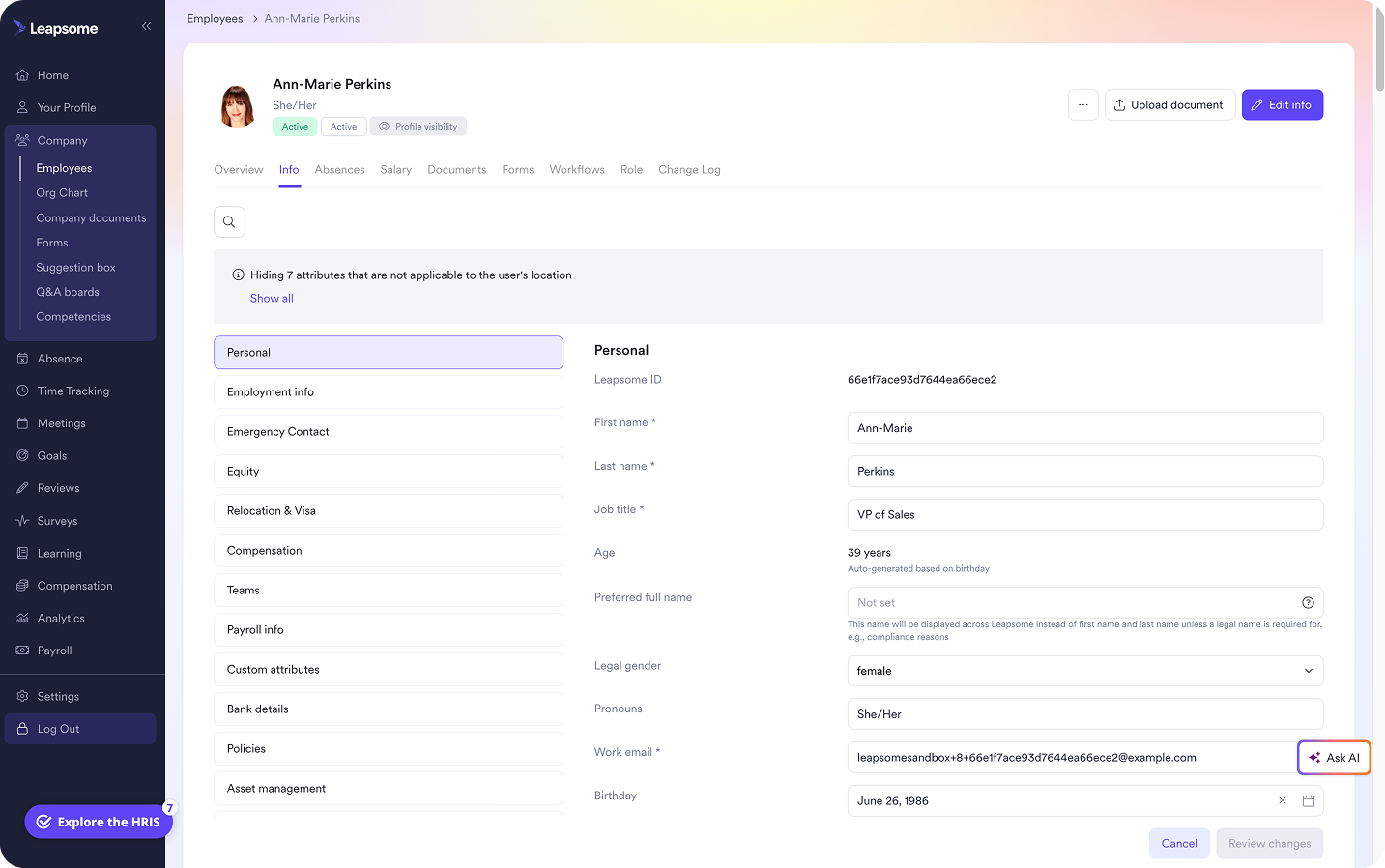
Calculating total compensation is a scramble when employee information like annual salary, bonuses, and benefits live across spreadsheets and disconnected systems. When you centralize this data, you give HR teams a solid foundation for compensation planning and analysis.
👉 Explore Employee Records
Evaluating whether a compensation package is actually competitive and fair
Creating a successful compensation package doesn’t solely depend on a strong total number. A higher figure doesn’t automatically mean compensation is better, and it won’t distract from an uncompetitive base salary. Likewise, a package composed of benefits that employees barely value is unlikely to attract top talent.
To pressure-test your compensation plan and focus on value over numbers, rely on these key dimensions:
- External competitiveness: How does compensation compare with appropriate market benchmarks for the role, level, and location?
- Internal fairness and consistency: Are employees doing comparable work compensated according to consistent principles? Are differences defensible and documented? Do all compensation decisions meet local compliance standards?
- Compensation mix and employee value: How much compensation involves a fixed paycheck versus variable pay, equity, and benefits? Do employees understand and value these components, or are they perceived as “filler?”
Generic benefits won’t do — go beyond standard work perks and match your compensation to your workforce’s needs. WorldatWork claims today’s employees value holistic needs, like physical, emotional, and mental priorities.
"Money is a sensitive topic, so communication is everything. Use clear, simple language and make sure leaders know how to talk about pay with confidence and care."
— Alexandra Edl, Senior HR Consultant, Interim Manager, Coach & Trainer at EDL Consulting
🔍 Ask employees about their rewards
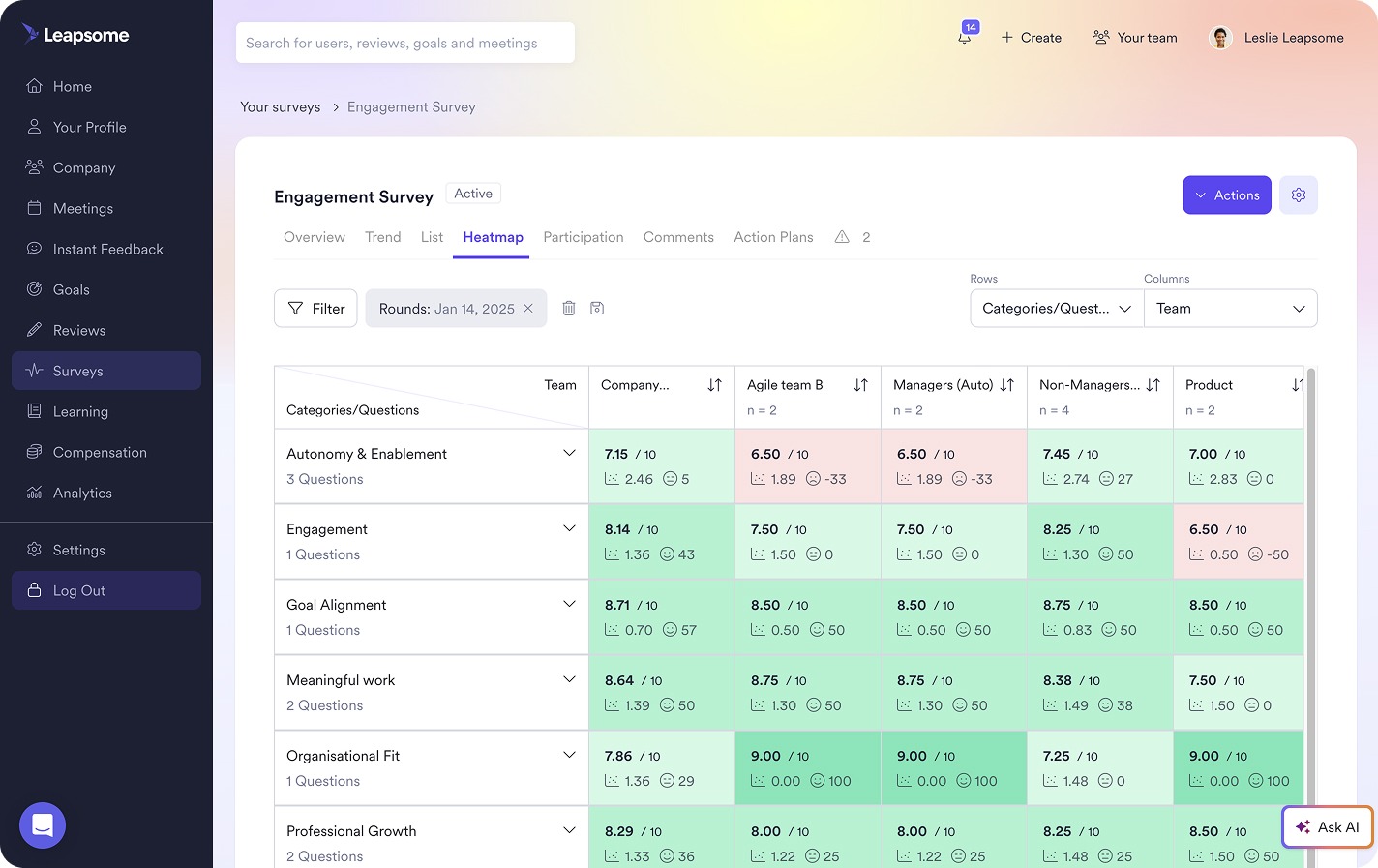
Employee perception underlies any successful compensation strategy. Leapsome can help HR teams identify concerns around pay fairness and understand where employee experience differs from the intended rewards strategy.
👉 Check out Engagement Surveys
Ground your total compensation strategy in data with Leapsome
"Creating pay bands means defining minimums, midpoints, and maximums for each role. It's not just a number, it's a system that supports fairness, clarity, and long-term growth."
— Alexandra Edl, Senior HR Consultant, Interim Manager, Coach & Trainer at EDL Consulting
Although calculating the total compensation for one employee can seem straightforward, maintaining consistency can be a real challenge. Especially as your business grows to 50, 100, or 250 employees
With added complexity, compensation becomes a broader issue of rewarding people according to objective, data-based decisions. If your calculations involve reconciling spreadsheets, employee records, and performance reviews, your compensation cycles can get lengthy and unreliable.
Leapsome helps HR teams connect compensation planning with employee records, performance, and development, enabling a more coherent strategy based on defensible data. HR professionals use Leapsome to:
- Support reusable compensation cycles: Compensation Management lets teams back manager proposals with real, structured data.
- Transform isolated calculations: Reviews, Goals, and Surveys help HR build repeatable processes, where performance, engagement, and employee perception is well-documented.
- Evaluate compensation metrics: Analytics display data across factors like teams, gender, and seniority to strengthen compensation equity and compliance.
Leapsome’s all-in-one HR software unifies your performance, engagement, and pay data, so you can consistently apply your compensation principles and build trust with your teams.
“With Leapsome, we were able to automate performance reviews, goal setting that was even prior, but now even further and onboarding and offboarding and that together helped us save about 20% of manual effort of our team.” — Weronika Czerny-Nowakowska, Chief Operating Officer | Neurons Lab
🌱 Support your company’s compensation principles
Pay fairness and transparency depend on having well-documented compensation data and cycles. Put your principles into practice by unifying performance, goals, and development on Leapsome.
👉 Request a demo.
FAQ
What’s a calculator for comparing base salary and total compensation?
A base salary and total comp calculator measures base pay and additional compensation like benefits and employer contributions. Salary alone doesn’t showcase a role’s full worth, so HR departments often use calculators to understand the true value of a job package. For example, a person’s base pay could be $60,000, but it reaches $75,000 with added benefits.