
PTO payouts: Calculation formula and laws by state


Disclaimer: This content is for general informational purposes only and does not constitute legal advice. Leapsome does not guarantee legal compliance and cannot confirm how specific situations would be assessed in court. If you're unsure how the requirements apply to your organization, please consult qualified legal counsel.
When an employee leaves a company, whether voluntarily or not, the same question comes up every time. Does the company owe the departing employee for unused PTO, and if so, how much?
This question seems simple at first, but the answer depends on several factors that go beyond the math: which state the employee works in, the organization’s written PTO policy, and the reliability of the underlying data. In fact, data is often where PTO payouts fall apart — the wrong inputs generate the wrong outputs. And it’s a safe bet that the problem is widespread: Only 5% of HR leaders at large organizations report that their talent data systems are fully connected.*
This guide explains how PTO payouts work, how to calculate them, and why the formula alone isn’t enough to get them right. You’ll also get a state-by-state guide to PTO payout regulations to help you apply the right rules.
* Korn Ferry, 2026
What’s a PTO payout?
A PTO payout or buyback is a payment an organization makes to a departing employee to compensate them for unused paid time off.
PTO is an umbrella term, often including accrued vacation time, paid sick leave, and floating holidays. But legally, most states that require PTO payouts focus on vacation payouts, with different rules for sick leave.
Many types of employee departures can trigger a PTO payout, such as voluntary resignation, termination, or retirement. And by law, some employers do have to pay out PTO. Whether buybacks are legally required depends primarily on which state the departing employee works in, as well as your organization’s internal policies if state regulations account for them.
How do you calculate PTO payouts?
Calculating PTO payouts comes down to a little basic math. For hourly employees, multiply accrued PTO hours by the employee’s hourly pay rate. For example, if a departing employee has 25 hours of accrued PTO and makes $25 an hour, their PTO payout comes out to:
25 hours accrued PTO × $25 an hour = $625 PTO payout
For salaried employees, you’ll need to work out an hourly rate equivalent for their annual salary. To do this, divide the annual salary by the number of hours in a standard full-time year, which is 2,080 (40 hours a week × 52 weeks a year). To illustrate, suppose a departing employee makes $62,400 a year. Then their hourly pay rate is:
$62,400 a year ÷ 2,080 hours = $30 an hour
Now, let’s say they have 30 hours of accrued PTO. Plugging this into the payout formula, you get:
30 hours accrued PTO × $30 an hour = $900 PTO payout
Of course, PTO payout calculations are only as good as the data that goes into them. If you don’t have accurate records of employee hours and PTO, the end result will be skewed.
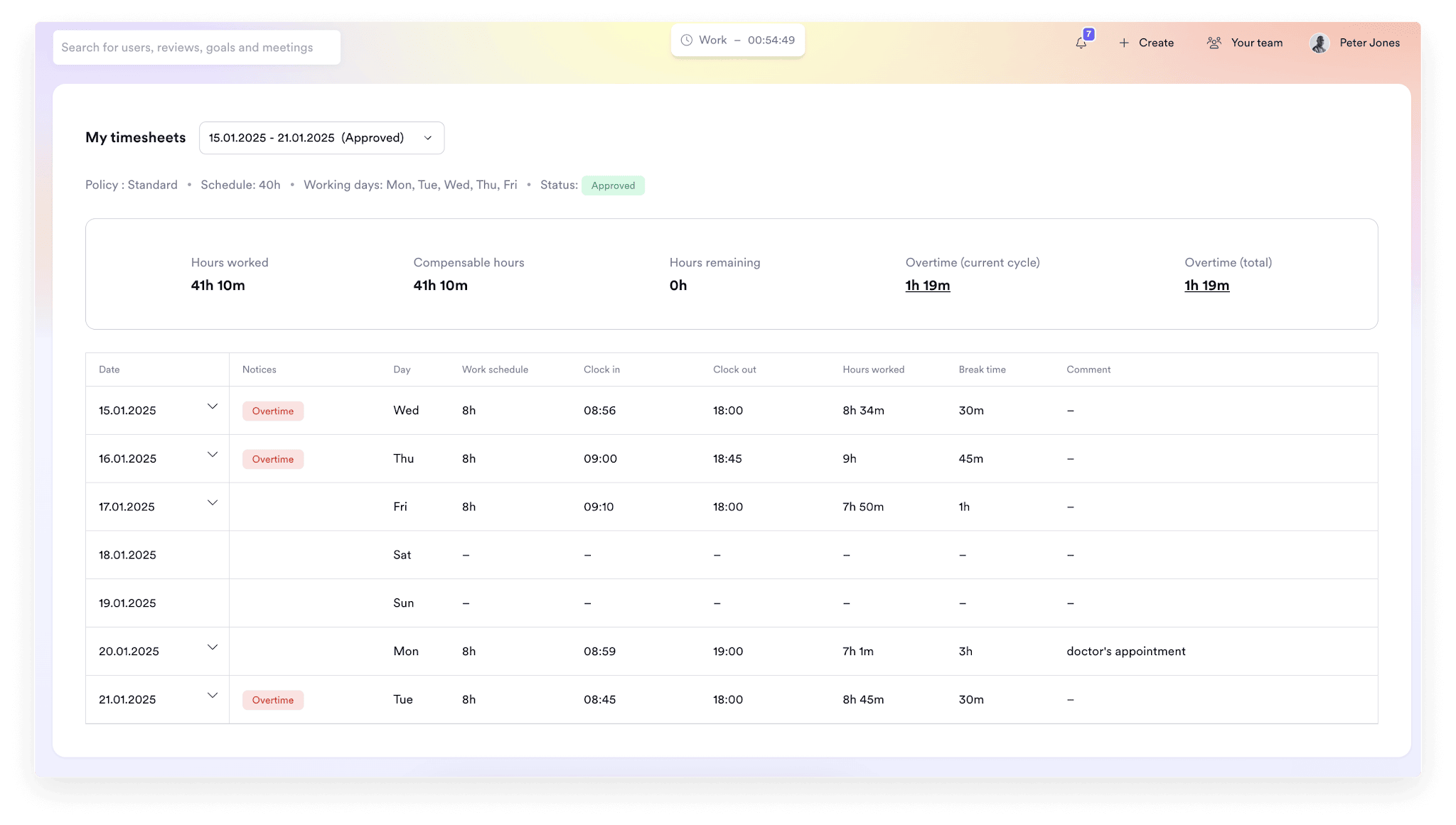
Clean inputs mean clean outputs — and Leapsome makes clean inputs automatic. Every time an employee requests paid leave, the platform notifies managers instantly. If approved, the employee’s PTO balance updates automatically, eliminating manual reconciliation during offboarding and the errors that tend to go with it.
"Admins can even schedule changes, like a new manager or team assignment, to take effect on a future date, and Leapsome applies them automatically."
— Sophie O'Donoghue, Customer Success Coach, Leapsome
✅ PTO tracking you can trust
Automatically sync PTO balances with employee records, payroll, and time tracking — no spreadsheets required.
👉 Explore Absence Management
Why PTO payouts are a data problem, not just a legal one
There are three key factors behind every compliant and accurate PTO payout.
- Understanding state-specific rules: PTO payout laws vary by state, so the first step is wrapping your head around what those regulations are. Keep in mind the rules apply based on where the departing employee works, not where your organization is headquartered.
- Working with accurate data: Calculating buybacks requires accurate, up-to-date accrued PTO balances. Keeping balances current at all times instead of reconstructing them from a spreadsheet helps you avoid errors and time sinks when it’s time for an employee to leave.
- Applying HR policies consistently: Consistent application of the company’s PTO policy keeps you compliant through every departure. This is especially important in the work-from-home era. Remote employees are more likely to be spread out across multiple states, which can complicate the laws involved if you don’t have a reliable process. And distributed work is widespread. As of July 2026, the U.S. Bureau of Labor Statistics reports that more than one in five (22.2%) of adult employees telework at least some of the time.
Are PTO payouts required by law? Buyback rules by state
There’s no federal legislation governing PTO payouts. That means whether they’re legally required depends entirely on the state the departing employee works in and the company’s own written HR policies.
Some companies offer unlimited PTO policies, which sidesteps buybacks. Since employees don’t actually accrue PTO, employers don’t have to pay it out when an employee leaves. And the number of companies offering unlimited PTO is rising — 12% in 2024, up from 9% two years prior, according to WTW research.
Here’s an outline of how PTO payout legislation plays out for each state.
Payout always required
Employees in these states are entitled to receive payments for unused PTO no matter what the employee handbook or employment agreement says.
- California
- Colorado
- Illinois
- Indiana
- Louisiana
- Maine (for employers with more than 10 employees)
- Massachusetts
- Montana
- Nebraska
- North Dakota (with certain exceptions)
- Rhode Island (if the departing worker was employed with the company for at least one year)
Payout required unless overridden by company policy
Only a few states allow companies to get around PTO payouts by explicitly excluding them in their written paid leave policy:
- Indiana
- Maryland (employee must be notified of forfeiture in writing)
- New Hampshire
- New York
- Wisconsin
- Wyoming (employee must acknowledge payout forfeiture)
Payout never required
Employers in these states are under no obligation to pay out unused PTO:
- Alabama
- Alaska
- Arizona
- Arkansas
- Connecticut
- Delaware
- Florida
- Georgia
- Hawaii
- Idaho
- Iowa
- Kansas
- Kentucky
- Michigan
- Minnesota
- Mississippi
- Missouri
- Nevada
- New Jersey
- New Mexico
- North Carolina
- Ohio
- Oklahoma
- Oregon
- Pennsylvania
- South Carolina
- South Dakota
- Tennessee
- Texas
- Utah
- Vermont
- Virginia
- Washington
- West Virginia
If your organization is on the hook for PTO payouts, managing them with fragmented systems won’t cut it. Leapsome’s modern HRIS connects configurable absence policies with time tracking, employee performance, and business goals, so compliance and efficiency are baked in instead of bolted on.
"You could have three different employee files, one in the system, one in the Google Drive, one in paper, that could all be different."
— Sammie Masley, People and Talent Partner, Leapsome
🔗 Set it and forget it
Customize built-in policies to turn time-consuming manual processes into an absence engine that runs itself.
👉 Explore HRIS features
An HRIS that supports payouts instead of skewing them
PTO payout mistakes can lead to unwelcome consequences. You might shortchange departing employees of cash they’re entitled to, and this may lead to costly wage claims. The good news is that both situations are avoidable with the right platform.
Leapsome Absence Management links PTO balances directly to employee records, complete with location information and customizable leave policies. PTO payouts are always based on accurate, up-to-date information instead of static, error-prone spreadsheets compiled by hand.
"The goal is to keep reducing those manual touch points."
— Sammie Masley, People and Talent Partner, Leapsome
But it doesn’t stop at managing leave. Leapsome is a full-featured AI-powered HRIS that connects the essential HR functions. Leave isn’t something bolted onto payroll as an afterthought — and neither are payroll, performance management, and onboarding.
"All payroll data lives in Leapsome, it's a living number. When salaries change, managers update them directly." — Siddharth Dhanuka, Head of Finance & Operations, SQUAKE
🧩 The last HRIS you’ll ever need
Connect the entire employee lifecycle, keep your data clean by default, and ditch the app-hopping for good.
👉 Request a demo
FAQ
Do you get paid out for unused PTO if you’re fired?
Whether terminated employees receive payouts for unused PTO depends on which state they work in and what’s in their former employer’s written PTO policy.
How are PTO payouts taxed?
The IRS classifies PTO payouts as taxable supplemental wages, which means all the usual withholding requirements apply, including federal income tax, state and local income taxes where applicable, and payroll taxes like Social Security and Medicare. Employers report PTO payouts on the employee’s W-2.

.png)


Automate, connect, and simplify all HR processes across the employee lifecycle.