
PTO accrual: How employees turn time worked into time off


Generous vacation time is a benefit potential talent notices immediately, and it’s at the top of HR leaders’ benefits lists, too. Data from SHRM shows that 81% of surveyed HR leaders claim paid leave is “very” or “extremely important,” second only to health insurance.*
Paid time off (PTO) is a necessity for employees’ well-being, but each company has different ideas about the “best” way to distribute vacation days. Some favor a straightforward lump sum each year, while others opt for the maximum flexibility with unlimited PTO policies. Sandwiched between these two strategies is the “accrued PTO” model, which gradually grants employees days off.
From a workplace planning perspective, PTO accrual does more than just help track vacation balances. It’s a way to balance financial liability management with the flexibility employees need to prepare for absences on their team. And with the right implementation, HR can use a PTO accrual policy to encourage much-needed breaks while managing workforce planning as you scale.
In this guide, we’ll explore what PTO accrual is and how the PTO structure you choose directly shapes company culture and employee well-being.
* SHRM, 2024
What’s PTO accrual?
PTO accrual spreads vacation day distribution throughout the year. Instead of getting all their allotted time off on one day (as in front-loaded PTO) or receiving unlimited PTO they can spend at will, employees in a PTO accrual structure receive their time off gradually throughout the year. Some frameworks provide this time off alongside hours worked, pay periods, or preset dates (such as on the first of the month), but the key trait they all share is that PTO comes steadily throughout the year.
How does PTO accrual work?
Of the many ways companies can distribute PTO, there are three common accrual structures:
- Hourly PTO accrual: In this model, employees receive their PTO based on the number of hours they work. For example, someone might get one hour of PTO for every 30 hours worked. This model makes PTO calculations simple for hourly workers.
- Per-pay-period PTO accrual: This accrual strategy gives employees a set amount of PTO each pay cycle. The “lump sum-like” nature of this strategy makes it the most straightforward for employees and payroll calculations, especially for salaried workers.
- Monthly PTO accrual: Sometimes, organizations set a specific timeframe to reward their PTO increments. For example, employees might receive a larger portion of their PTO at the start of every quarter.
How to calculate PTO accrual
Every formula for calculating PTO accrual involves dividing the total days by your distribution rate.
If you’re using a per-pay-period PTO model, divide your annual PTO hours by the number of pay periods to get the PTO per pay period. If an employee receives 120 hours of PTO annually and gets paid bi-weekly (26 pay periods), for example, then they receive 4.62 hours every pay cycle.
With an hourly PTO strategy, you’ll divide the annual PTO allotment by the annual hours worked. Suppose an employee receives 80 hours of PTO per year and works 2,080 hours (the equivalent of a 40-hour-per-week full-time job). They would get 0.0385 hours of PTO per hour worked, or about one hour of PTO for every 26 hours worked.
For organizations using a monthly PTO strategy, simply divide the annual PTO allotment by 12. An employee who receives 100 hours of PTO annually will see 8.33 hours added to their statement every month.
What’s a good PTO accrual rate?
Competitive PTO accrual rates depend on factors like your company’s size and industry benchmarks, as well as what countries your employees are based out of. In the United States, a common average is 11 days per year, and most companies pay between 0.03 and 0.06 PTO hours per hour worked (or 7.8 to 15.6 days for a traditional full-time role).
The amount of accrued PTO often increases with tenure (e.g., five more days after two years, then another five for every five years of service) as an incentive for long-term retention.
Just know that whether your PTO accrual rate is “good” isn’t solely based on how many days you give. Rather, you should focus on whether your PTO policy gives your employees enough grace to take care of themselves without feeling pressured to stockpile their hours.
Common reasons PTO accrual succeeds or fails
PTO calculations and total hours often take center stage in conversations about time off, but company culture plays a bigger role in whether employees actually feel comfortable taking time off. Employees who have plenty of PTO might still be getting the sense that they shouldn’t step away, even if it’s not said outright.
Here are a few of the most common reasons employees are hesitant to cash in on their time off.
Managers create unofficial barriers to time off
It can be hard to pull away from the office — even when employees know the time off is a benefit they should use — when direct managers put on a sad face over the request. Hesitation or subtly shaming comments could make employees feel like there are “better times” to book off rather than setting PTO on their terms. In some cases, that “better time” never comes, creating a perfect storm for burnout.
High PTO balances can signal burnout risk
Sometimes, the structure of accrued PTO feels more like a savings account than a working bank. In 2023, Pew Research found that 48% of U.S. employees reported not taking all the time off that was offered to them. When PTO feels scarce, it encourages hoarding that time for an emergency or a longer vacation. But without proper self-care, your workforce might be technically covered but mentally drained, hurting your operational productivity and the employee experience.
When time off becomes something your employees postpone indefinitely, the underlying causes (such as understaffing or high workload demands) are likely contributing to burnout. HR leaders need to connect the dots and find ways to encourage employees to take their time off by fixing those problems at the source.
It can be hard to solve those people problems when you don’t have visibility into the connection in the first place. With Leapsome’s leave management suite, your employees can instantly see how much time off they have and request PTO. And with Leapsome AI, your HR team can track long-term PTO trends to identify patterns in your leave policy like high absenteeism or never taking days off.
"We even flag compliance risks — for example, if a country requires a minimum of 20 paid days off, the platform won’t let you go below that."
— Suraj Paneru, Customer Success Coach at Leapsome
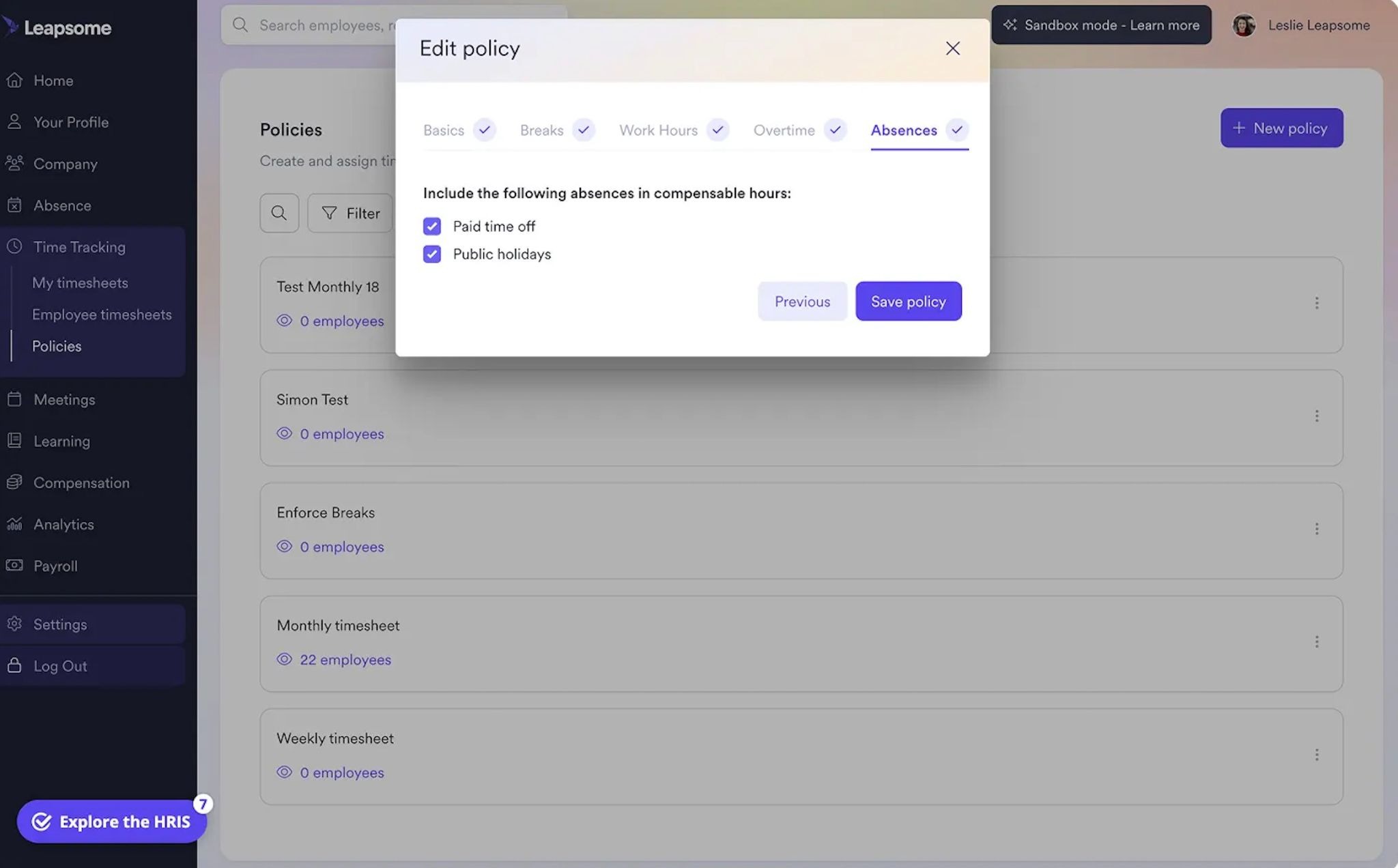
🧘 Support employee well-being with smarter PTO tracking
Leapsome centralizes your PTO accrual and absence data so you can spot burnout warning signs early and keep teams properly staffed to encourage self-care.
👉 Explore Absence Management
How to tell if your PTO policy is supporting employee well-being
“I had to become quite militant with calendar scheduling. Once I started staggering my hours — late starts some days, early starts others — I stopped burning out and became far more productive.”
— Noelle Pittock, Senior Director, Onboarding Operations and Business Operations at Remote
A PTO policy can be perfectly people-first on paper and still miss the mark in practice. Success is less about the plan’s structure and more about whether or not your employees are using it as intended. Here are a few common warning signs that signal employees aren’t taking the time to recharge:
- PTO utilization rates remain low: When employees have time off but choose not to use it, this may signal cultural issues, such as a fear of falling behind or of being perceived as “less committed.” Policy choices — particularly flexible policies like unlimited PTO, where it’s unclear what a “normal” amount of time off looks like and requests can vary wildly between employees — can exacerbate this issue.
- Employees consistently carry large PTO balances: While some PTO carryover is normal and big trips require a little extra saving and planning, employees who regularly have large amounts of unused PTO likely aren’t getting the rest they need. Whatever the reason, large balances are alarms signaling a strained work-life balance.
- Certain teams rarely take time off: Whenever you notice specific departments aren’t using all their PTO, it’s worth taking a closer look. Teams who are outliers in your PTO data might signal issues with leadership or understaffing that unfairly affect certain groups of employees.
Even with detailed PTO data, it can be difficult to see how these numbers map onto morale. One way to uncover these trends in your PTO policy is to link them to ongoing feedback. For instance, with Leapsome’s Engagement Surveys feature, HR can monitor how your teams feel about their job throughout the year and compare these people analytics with PTO spending, all in one centralized HRIS.
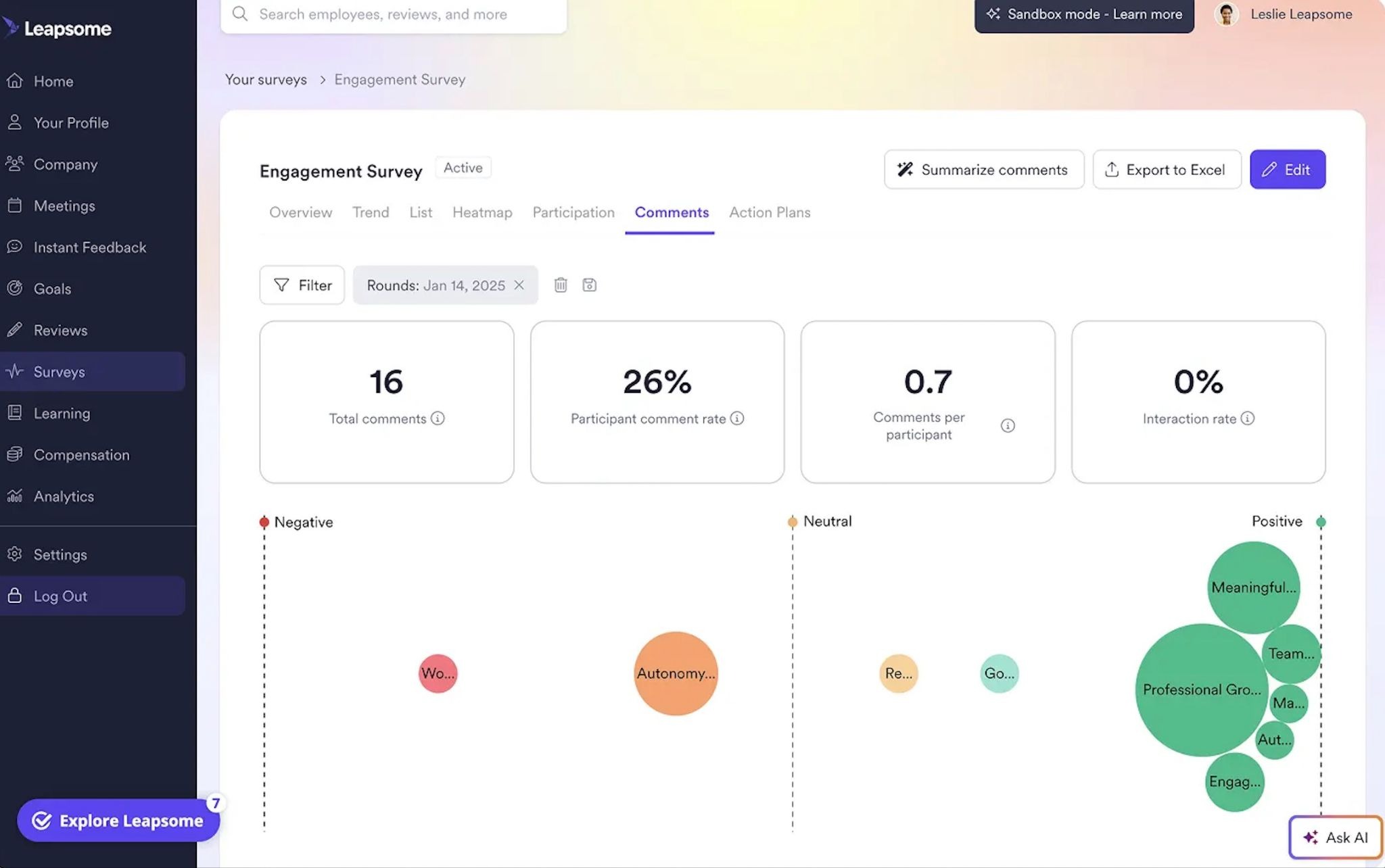
🖼️ Get the full picture on PTO trends
Leapsome’s Engagement Surveys feature connects ongoing feedback with leave data so you can tailor your PTO policy to your employee’s needs.
👉 Explore Engagement Surveys
Manage PTO accrual and employee leave with Leapsome
Managing PTO manually is bound to create a mess. With so many moving parts and calculations, it’s easy to underestimate just how complicated the people parts of PTO can be. It’s one thing to know how much PTO an employee has, and another altogether if they’re taking enough time off — not to mention gleaning any insights about company culture from broader workforce trends.
Leapsome can take the strain out of PTO management by keeping your data in one transparent, centralized HRIS, so HR can make sure employees actually relax. Here are just a few ways Leapsome can help you perfect your PTO processes:
- Set and forget your accrual PTO rules: Leapsome lets you customize and automate accrual and carryover rules to minimize the risk of calculation errors.
- Standardize leave request workflows: Make it simple for employees to submit their time-off requests and for managers to approve them, with full visibility into who’s out on a company-wide calendar.
- Compare PTO data with engagement: With Leapsome’s Engagement Surveys, HR can gather and analyze more feedback to find correlations between their PTO policy and employee sentiment.
- See more with Leapsome AI: Leapsome’s AI assistant helps you take faster action on your absence data trends.
“Dashboards remove the detective work. If a leader has a gut feeling about absence spikes, they can verify it in seconds and act. Real-time beats month-old exports every single time.” — Florian Klages, Managing Partner at torq.partners
🌴 Support healthier time-off habits with PTO visibility
With PTO accrual and engagement surveys in one place, Leapsome’s HRIS and talent management system makes it easy for HR to spot burnout risks and encourage employee well-being.
👉 Request a demo
FAQ
Is unlimited PTO better than accrued PTO?
Unlimited PTO is a major perk for employees who value flexibility, and it reduces the administrative burden of tracking accruals. Without a strong company culture, though, this model can backfire as employees wonder what a “reasonable” time-off request looks like. It’s clear how much PTO an employee can (and should) take each year with an accrued PTO strategy, even though it requires more meticulous tracking.

_under_300kb.jpg)