What your HR-to-employee ratio really tells you


Just about every time budget season or a headcount review rolls around, one question resurfaces: What HR-to-employee ratio should you target? In a climate where 55% of HR professionals report being short-staffed, it’s a question leaders can’t ignore.*
The challenge is that the answer can be hard to pin down. Different benchmark reports give different numbers depending on their methodology and the industries they focus on.
That’s why benchmarks only serve as a useful baseline. HR-to-employee ratios only become truly meaningful when they’re situated alongside organization-specific factors like HR capacity, operating efficiency, and business demand.
This guide provides a simple decision framework to evaluate whether your HR-to-employee ratio fits your company’s needs. You’ll learn why ratios alone rarely reveal usable insights, which details to weigh, and when adding HR staff might be a smart idea.
* SHRM, 2026
What’s a good HR-to-employee ratio? Formula and benchmarks
Calculating an FTE ratio is straightforward. The equation compares your HR department’s full-time equivalents (FTEs) to your organization’s total FTEs:
HR-to-employee ratio = HR FTEs ÷ total FTEs × 100
Using FTEs instead of raw headcount gives you a more accurate picture because it accounts for part-time roles proportionally. For example, suppose you’re a smaller company with one full-time HR staff member, one part-time HR staff member who works 20 hours a week, and 50 total FTEs across the organization. Your HR-to-employee ratio comes out to three HR staff for every 100 employees:
1.5 HR FTEs ÷ 50 total FTEs × 100 = 3
There’s no magic number that defines the ideal HR-to-employee ratio. In 2025, SHRM research found a median HR-to-employee ratio of 1.98. But benchmarks vary significantly, from roughly 1.4 to 2.6 HR staff per 100 employees, depending on who’s reporting the numbers. The results vary because of differences in company sizes, industry-specific compliance requirements, and how each study defines HR work.
Instead of relying on industry benchmarks alone, focus on three core areas to decide whether your ratio genuinely signals understaffing:
- HR capacity: Are you falling behind on day-to-day or strategic work because team members have too much on their plates?
- Business demand: Are changes like international expansion, growing compliance complexity, or the increased workload that accompanies high turnover stretching your team thin?
- Operating efficiency: Are you spending too much time on repetitive administrative work instead of using automated processes or employee self-service portals?
“We’ve been able to optimize and automate a lot of the functions that were taking up our time, turning them into one streamlined workflow that connects departments like onboarding, offboarding, training, and hiring. The result is less hassle, more communication, and more time for value-add work.
— Janelle Daugherty, Head of People & Culture, Notion Health
If your answer to any of these questions is yes, you might be facing a real capacity problem. To make a convincing case, however, you need a way for HR and finance to align on the same workforce data. That’s where Leapsome helps.
“The goal is to keep reducing those manual touch points.”
— Sammie Masley, People and Talent Partner, Leapsome
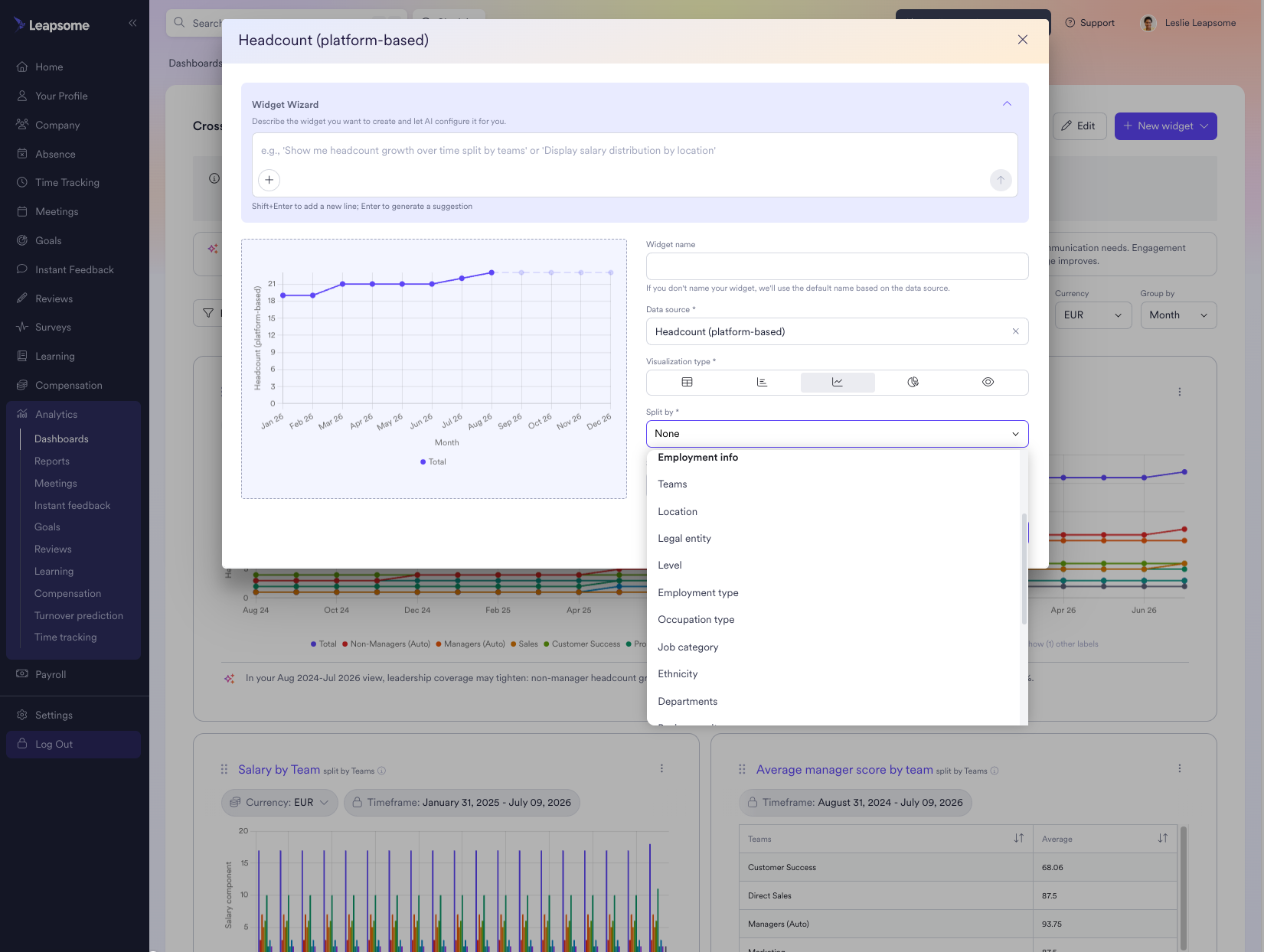
📊 Headcount insights without the spreadsheets
Track headcount over time and break down the data by attributes like employment info, team, and location to investigate capacity concerns with quantitative precision.
👉 Explore People Analytics
Why HR-to-employee ratios don’t tell you much in isolation
No two organizations are the same. Consider two mid-sized companies with 100 employees each. CalmCorp is stable, automates repetitive administrative tasks, and takes full advantage of self-service employee portals. Chaos Inc. is hiring rapidly but still handles most administrative HR functions by hand, leaving little time to implement strategic initiatives.
Suppose both companies have two full-time HR staff members, for an HR-to-employee ratio of exactly two (2 ÷ 100 × 100 = 2). On paper, the situation is identical. In practice, it’s more than likely that CalmCorp’s HR department is comfortable and high-performing while the team at Chaos Inc. is stretched to its breaking point.
This scenario shows the fundamental limitation of comparing HR-to-employee ratios to industry benchmarks. Because organizations vary so widely, there’s no universal number that can tell you where your ratio stands.
Try this simple three-part decision framework to convert your findings into action instead:
- Is strategic work still delayed even though operations are efficient? This could point to a genuine headcount gap.
- Are business demands outpacing capacity? Get clear on whether it’s a long-term trend or a temporary adjustment period due to a hiring surge or one-off reorganization. If it looks like a lasting shift, you might have a real shortage on your hands.
- Is the administrative HR burden too high? Streamline your processes by automating workflows and implementing employee self-service portals, then see where you stand.
“Many employees thought we were leaning into AI to downsize, not to maximize impact. They were scared.” — Melanie Naranjo, Chief People Officer, Ethena
The real value of HR tech isn’t reducing headcount. It’s helping your existing team support the business more effectively. A Gartner survey revealed that HR leaders expect an average HR headcount decline of just 5.1% from generative AI adoption. Leapsome’s AI Agents were built to free HR teams from manual work so they can focus on impact.
💪 Do more with what (and who) you already have
Let AI Agents handle ordinary admin work so your team can focus on the extraordinary.
👉 Explore AI Agents
When does it make sense to add more HR staff?
It’s rarely wise to hire new staff just because your HR-to-employee ratio is lower than average. Every HR department has to decide for itself when it’s time to hire, but there are signs that can help point the way.
One of the clearest is when HR support becomes a bottleneck instead of a catalyst. Response times get slower while requests pile up, leaving employees and managers waiting for the answers they need to move forward.
Another indicator is when strategic work like performance initiatives or employee development fall by the wayside even after you’ve streamlined routine admin work. This is a widespread problem, with research by Robert Half showing that just 7% of HR leaders have the headcount and capabilities they need to complete priority projects. Identifying which projects are stuck in limbo also gives capacity conversations the specificity finance teams and leadership can align around.
Ultimately, your HR-to-employee ratio is a good place to start, but only a careful examination of your HR team’s day-to-day reality can show what you truly need.
Bring hard data to headcount conversations with Leapsome
Headcount discussions fall apart when it’s not backed by real data. Leapsome’s People Analytics gives HR and finance teams a shared source of truth. With Leapsome, you get:
- Employee records: Up-to-date role, team, and location details that show how your organization is structured.
- People analytics filters: Segmented views of headcount, tenure, and team composition that help you compare groups and understand capacity distribution.
- Engagement surveys: Sentiment data that highlights how employees experience workload and support.
- Performance reviews: Structured cycles that show development progress and areas where teams or managers need additional support.
Leapsome’s AI Agents complement your new data foundation by helping you do more with the team you already have. Run onboarding, offboarding, and virtually everything in between more efficiently than ever before.
If you’re looking for a way to turn empty benchmark-chasing into evidence-based decision-making, you’ve found it in Leapsome.
“Our first impression was, okay, the team will enjoy using this tool. It’s intuitive. We don’t need to do much onboarding.” — Siddharth Dhanuka, Head of Finance & Operations, SQUAKE
🚀 One HR platform for insight and impact
See how Leapsome can help you unify your data, generate contextual insights, and multiply what your team can do.
👉 Request a demo
FAQ
Does HR software change what the ideal ratio should be?
Not directly. While HR software can help HR staff handle more work, HR leaders on average believe that the headcount impact of adopting new technologies like generative AI is modest. How many HR people per employee your organization needs ultimately depends on your company size, industry, and efficiency.
How do you calculate the HR-to-employee ratio?
Divide your HR FTEs by your organization’s total FTEs and multiply by 100:
HR-to-employee ratio = HR FTEs ÷ total FTEs × 100
For example, if you have 4 full-time HR staff and 250 full-time employees overall, your HR-to-employee ratio comes out to:
4 HR FTEs ÷ 250 total FTEs × 100 = 1.6