Cost of employee turnover: What it actually adds up to


Gallup estimates that replacing an employee costs 50% to 200% of their annual salary.* For a role paying $100,000, that puts the cost of employee turnover anywhere from $50,000 to $200,000. Finance can’t make a useful budget decision from a gap that wide, and the numbers don’t show which part of the cost your retention work could reduce.
A stronger estimate starts with what your organization spends to fill a role, like job ad expenses or time spent getting new employees up to speed. It should also account for lost work while the position sits vacant and potential loss of long-standing customers.
In this article, you’ll learn how to calculate turnover costs using your own data and identify which ones you can reduce.
* Gallup, 2024
What employee turnover actually costs, input by input
"HR often gets forgotten when it comes to strategic objectives, yet we're just as critical to the business outcomes as any other function. The first step is defining exactly what we want to achieve with our people strategy, then everything else should ladder up to those measurable goals."
— Monica Sarkar, Co-Founder, Purple Umbrella
The cost of employee turnover is the money your organization spends, plus the value of work it loses, when an employee leaves and you replace them.
Gallup found that voluntary turnover costs U.S. businesses $1 trillion a year. That shows the scale of the problem, but your budget case needs your organization’s numbers. To find your estimate, start with the direct costs you can trace to a departure, then approximate lost output where you have enough evidence to do so.
Here’s how to calculate employee turnover cost with your data:
Invoices and recorded hours usually give you the most verifiable figures. Vacancy and ramp costs need more judgment. Ask the manager what work the team completed during each period and what fell behind. If colleagues covered the full workload through paid overtime, count that overtime rather than counting the work as lost. This keeps the estimate credible.
For example, an employee leaves a role that takes four weeks to fill. You record $300 in exit administration and $3,600 in recruiting spend and interviewer time. The team loses an estimated $4,000 in output while the role is vacant. Training the replacement costs $1,200, and the output gap during their first eight weeks adds $4,000. The estimated cost of this departure is $13,100.
While these are illustrative figures, they give you a better understanding of the data behind each input you can enter into an employee turnover cost calculator or spreadsheet.
You may also have indirect costs, like losing institutional knowledge. A customer relationship may suffer, or the remaining team may take on more strain. Include a dollar figure for any of these effects only when you can point to a measurable loss. You can describe the rest as risks without padding the total.
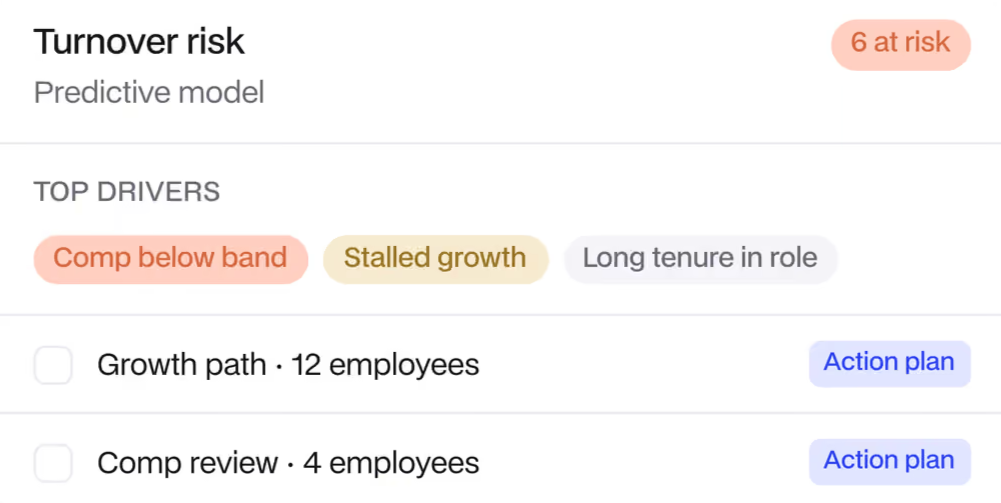
While it varies, turnover always has a price tag, and it’s best to prevent a loss rather than reduce the cost. Catch issues before they unfold — use Leapsome’s People Analytics to predict turnover and improve employee retention.
🕵️ Spot the retention risk on time
Leapsome’s People Analytics includes turnover prediction to help you spot potential risk and reveal why people choose to stay, so you can address issues on time.
👉 Explore People Analytics
Why the industry-average range isn't a budget number
"If we have someone leaving and then maybe they receive a later bonus payment, that's something that needs to be flagged because that payment is going to be booked in a completely different way." — Sammie Masley, People and Talent Partner, Leapsome
The 50% to 200% salary range describes what a departure might cost. A budget needs to account for how often that cost is likely to happen. One hard-to-replace specialist may be expensive to lose, while repeated departures from a more common role can create a higher annual cost. A single company-wide multiplier often hides that difference.
Start with your cost per departure for each role or team, then apply the turnover you expect from the budget period. That gives you an estimate of your annual exposure. From there, you can make a more precise case for action. A faster hiring process may reduce vacancy costs for every replacement. A retention initiative may prevent some departures altogether, but its savings depend on how many people it helps you keep. Don’t claim the full cost of every departure as a saving unless your proposal could plausibly prevent them.
Assumptions also need a review date. Express Employment Professionals reported an average turnover cost of $45,236 in 2026, compared with $36,723 the year before. That change in one survey doesn’t prove your costs will rise, but it’s a good reason to revisit the figures behind your budget rather than carrying forward last year’s estimate.
Find out what’s behind the turnover number
"Disagreement versus disengagement. Disagreement is solution-oriented and linked to goals. Disengagement is pushback for the sake of pushback, sometimes it's time for an amicable exit."
— Stephanie Shuler, Chief People Officer, LifeLabs Learning (at the time)
Your turnover estimate can show which teams account for the greatest potential cost. It can’t tell you what employees in those teams are experiencing. In a Gallup study, 42% of employees who left voluntarily said their manager or organization could have done something to prevent their departure. That’s a reason to look for concerns while people are still with you — before you decide what retention strategies to fund. Here’s how:
- Watch for changes in sentiment: A decline over several survey rounds tells you more than one low score. Look at which concerns have become more common.
- Compare teams: If one team reports a growing workload problem while similar ones don’t, start with that team’s working conditions. A company-wide program may miss the cause.
- Check whether your response helps: Give managers a specific concern to address, then use later feedback to see if employees notice a difference.
"Too many organizations collect feedback that never sees daylight, and that's where engagement dies. When you share results quickly, involve leaders in decisions, and clearly communicate the actions being taken, employees can see their input creating real change."
— Monica Sarkar, Co-Founder, Purple Umbrella
Survey trends show you what needs attention in a team with high turnover risk. You can then make the case for a targeted change, using the cost estimate to show what’s at stake.
⏪ See which turnover costs you may be able to prevent
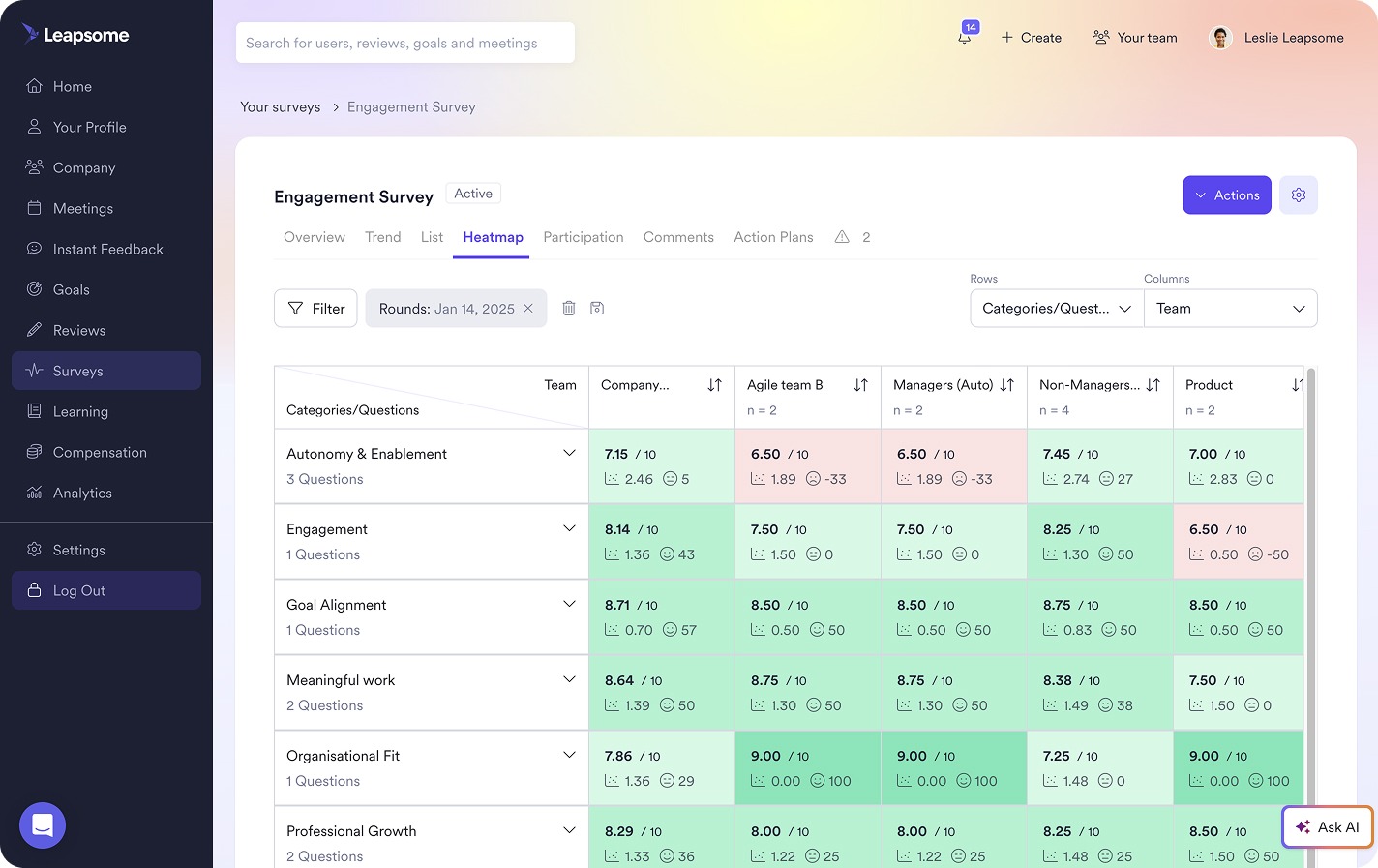
Leapsome’s Engagement Surveys show where team sentiment is changing, helping you focus retention efforts before vacancy and replacement estimates become real expenses.
👉 Explore Engagement Surveys
Leapsome: Catch the cost of turnover before it happens
Once someone resigns, you can calculate the cost of replacing them. The better budgeting opportunity comes earlier, when a team’s feedback starts to change, and its managers can respond. Leapsome helps you connect those signals to the turnover costs you calculated. With Leapsome, HR teams can use:
- Engagement Surveys: Track changes in employee feedback by team. If a team’s scores fall, you can look at the survey results to understand what needs attention.
- Feedback: Turn the instant feedback into an action with an owner and a due date. Managers can address the issue employees raised while there’s still time to prevent a departure and its costs.
- People Analytics: Use engagement data to estimate turnover risk by team. You can compare teams with higher expected turnover against your cost estimates and decide where to focus retention work first.
"All payroll data lives in Leapsome, it's a living number. When salaries change, managers update them directly." — Siddharth Dhanuka, Head of Finance & Operations, SQUAKE
📈 Act before turnover costs add up
Leapsome connects employee feedback with turnover predictions, so you can focus retention efforts where they make the biggest difference.
👉 Request a demo
FAQ
What's the average cost to replace an employee?
Gallup and SHRM estimate that replacing an employee can cost 50% to 200% of their annual salary. For someone earning $60,000 a year, that puts the estimated cost between $30,000 and $120,000. The wide range shows why an industry average might be a starting point, but not a figure you can use in your own budget.
How is the cost of turnover different from the turnover rate?
The cost of turnover estimates the financial impact of employees leaving. The turnover rate shows what percentage of employees left during a given period. One tells you how much departures cost; the other tells you how often they happen.
How do employee type and seniority affect turnover costs?
An entry-level role may be quicker to fill, but frequent departures can make its total cost significant. When a senior employee is departing, a longer vacancy may reduce productivity and affect team morale, on top of regular turnover costs. Estimate costs by role so you can focus employee retention strategies where they matter most.

.jpg)



.png)