
How a compa-ratio works and why it matters

%2520(1).png)
Almost two in three (63%) of employees paid at market rate believe they’re paid below it. And 47% of employees who are actually paid above market rate believe they’re paid below market.* These employees are 45% more likely to look for a new job in the next six months than those who feel fairly compensated, posing a serious retention risk. How can organizations close the gap between perception and reality?
One widely used tool that can help is the compa-ratio, a metric that compares compensation to industry or demographic benchmarks for quantitative insights into how employee salaries really stack up. While they can’t make pay decisions for you, compa-ratio calculations provide a useful jumping-off point when combined with broader workforce data about performance, tenure, and skills.
This guide explores how to calculate compa-ratios and use them with other metrics to make informed, consistent decisions about compensation and internal equity initiatives.
* Payscale, 2025
What’s a compa-ratio?
Compa-ratio (short for comparative ratio) is a metric HR professionals use to compare the base salary of an employee or group of employees to a specific salary range. It’s often measured against industry benchmarks for specific roles to see how an employee’s salary matches up with market rates. Teams can also use it within their organizations to evaluate salaries between colleagues, departments, and demographic groups. This supports internal equity initiatives by uncovering unjustified gaps.
How do I calculate the compa-ratio?
If you prefer doing math by hand to using a compa-ratio calculator, the equation is straightforward. Just divide the employee’s annual base salary by the midpoint of the salary range for similar positions and multiply by 100 to get a percentage:
Employee's annual base salary Salary range midpoint 100
For example, if an employee earns $45,000 and the midpoint of the salary range for their role is $50,000, the compa-ratio formula looks like this:
$45,000$50,000 100 = 90%
What different compa-ratio salary ranges reveal
“Once you know the market benchmark, the real challenge is matching it to your internal reality. Who’s above or below band and why? Can it be objectively explained?”
— Alexandra Edl, Senior HR Consultant, Interim Manager, Coach & Trainer, EDL Consulting
Compa-ratios tell different stories based on how close to the midpoint they fall.
- Below the midpoint: If a compa-ratio is below 100%, the employee makes less than the midpoint for the pay range you’re comparing against. Many organizations consider a compa-ratio of 80% to be acceptable for employees with less experience. If the ratio is below 80%, the employee may be underpaid.
- Near the midpoint: A compa-ratio of 100% indicates an employee’s salary is in line with typical compensation for comparable roles.
- Above the midpoint: A compa-ratio of up to 120% suggests that an employee is paid above the market. This level of pay is appropriate for employees with long tenure or consistently strong performance. If the compa-ratio is above 120%, you may be overpaying that employee.
Compa-ratios as conversation starters, not final rulings
Compa-ratios don’t have the final say on whether a particular salary decision makes sense. They’re tools designed to help you ask the right questions.
“If two employees have the same compa-ratio, would you necessarily make the same compensation decision for both?”
If your instinct is to say yes, you may be looking to compa-ratios as the be-all and end-all instead of what they really are: just one part of the puzzle.
Interpret compa-ratios alongside performance data
Research conducted by Salary.com revealed that 21% of organizations lean mostly or entirely on individual manager discretion for pay decisions. Leaving these decisions up to managers’ subjective opinions can create inconsistency in an organization. Pairing compa-ratios with performance data creates a shared, objective foundation managers can draw on to inform and justify their decisions.
Factor in differences in role scope and complexity
Two employees can share a job title while managing very different levels of responsibility. When this is the case, a discrepancy in compa-ratios that may look troubling at first glance can be well-justified. Weigh compa-ratios against each employee’s workload to determine whether a seemingly inconsistent pay decision is defensible in practice.
Seek out patterns across teams, not just individuals
“Pay gaps show the average difference between groups, but that doesn’t tell the full story. Pay equity means comparing like with like: same role, same experience, same performance.”
— Alexandra Edl, Senior HR Consultant, Interim Manager, Coach & Trainer, EDL Consulting
A single outlier in pay might be an anomaly. When the ratio spread widens across teams or demographic groups, it might be a symptom of something deeper. Zoom out and think about the root cause, whether that’s a genuine pay inequity or simply a difference in tenure or skill.
The smartest (and simplest) way to uncover these patterns is by using HR software that does the heavy lifting for you. Leapsome helps you make fair pay adjustments by grounding decisions in performance, engagement, and workforce data.
“Employees can now find everything in one place — their data, absences, goals, and reviews. I don’t have to explain which tool to use for what. It’s all in Leapsome.” — Merilyn L, Senior People Operations Specialist | Bob W
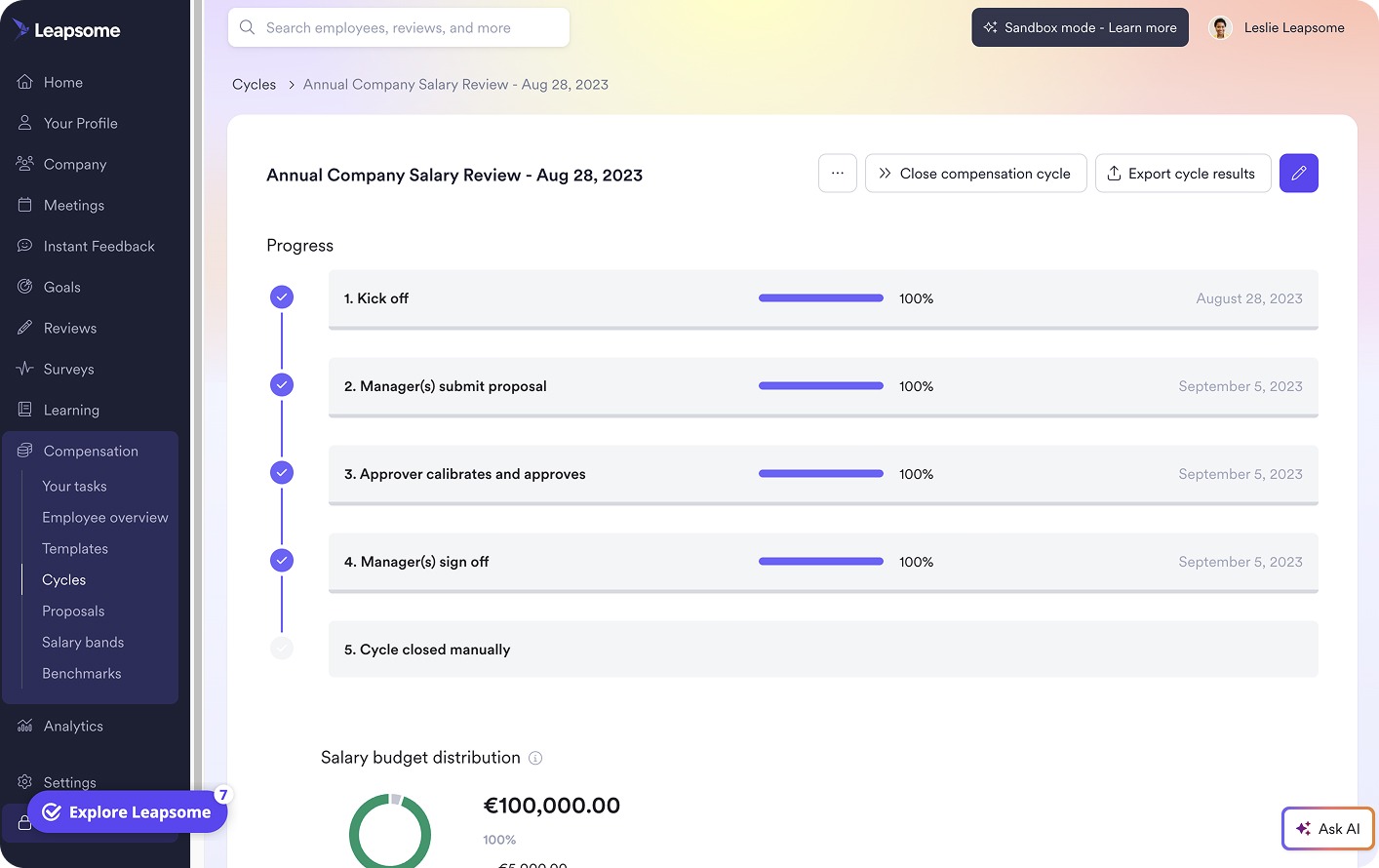
📖 Tell the whole story with fair pay decisions backed by data
Link compensation insights to performance, engagement, and workforce data so you can rest easy knowing you’re always working from a holistic view of your people.
👉 Explore Compensation Management
How to use compa-ratios to refine your compensation strategy
More than two-thirds (68%) of executive leaders see compensation as a strategic lever for achieving business outcomes, according to Payscale. Here are three ways to incorporate compa-ratios into an ongoing compensation strategy.
Compare against trustworthy data
“Free sources like Glassdoor are fine for a first impression, but they’re often incomplete or inconsistent. You need real-time, validated data, especially in fast-changing or high-inflation markets.”
— Alexandra Edl, Senior HR Consultant, Interim Manager, Coach & Trainer, EDL Consulting
A compa-ratio is only as good as the salary data you measure it against. If your data is poor or outdated, your result will be completely misleading. Periodically double-check that your benchmarks still reflect current market rates.
Be proactive about reviewing compensation data
“Pay equity cannot be achieved without data integrity.”
— WorldatWork, 2023
Waiting for the next annual review cycle to roll around lets pay equity problems fester before anyone catches them. A regular cadence of reviews, perhaps annually or every six months, keeps data fresh and helps you spot issues before they snowball into retention crises.
Treat compensation as one pillar of broader talent decisions
The best compensation decisions draw on a wide range of signals, from performance reviews to workforce and succession planning goals. A compa-ratio might tell you whether someone is under or overpaid, but bringing in the rest of the context is what tells you what you can do about it.
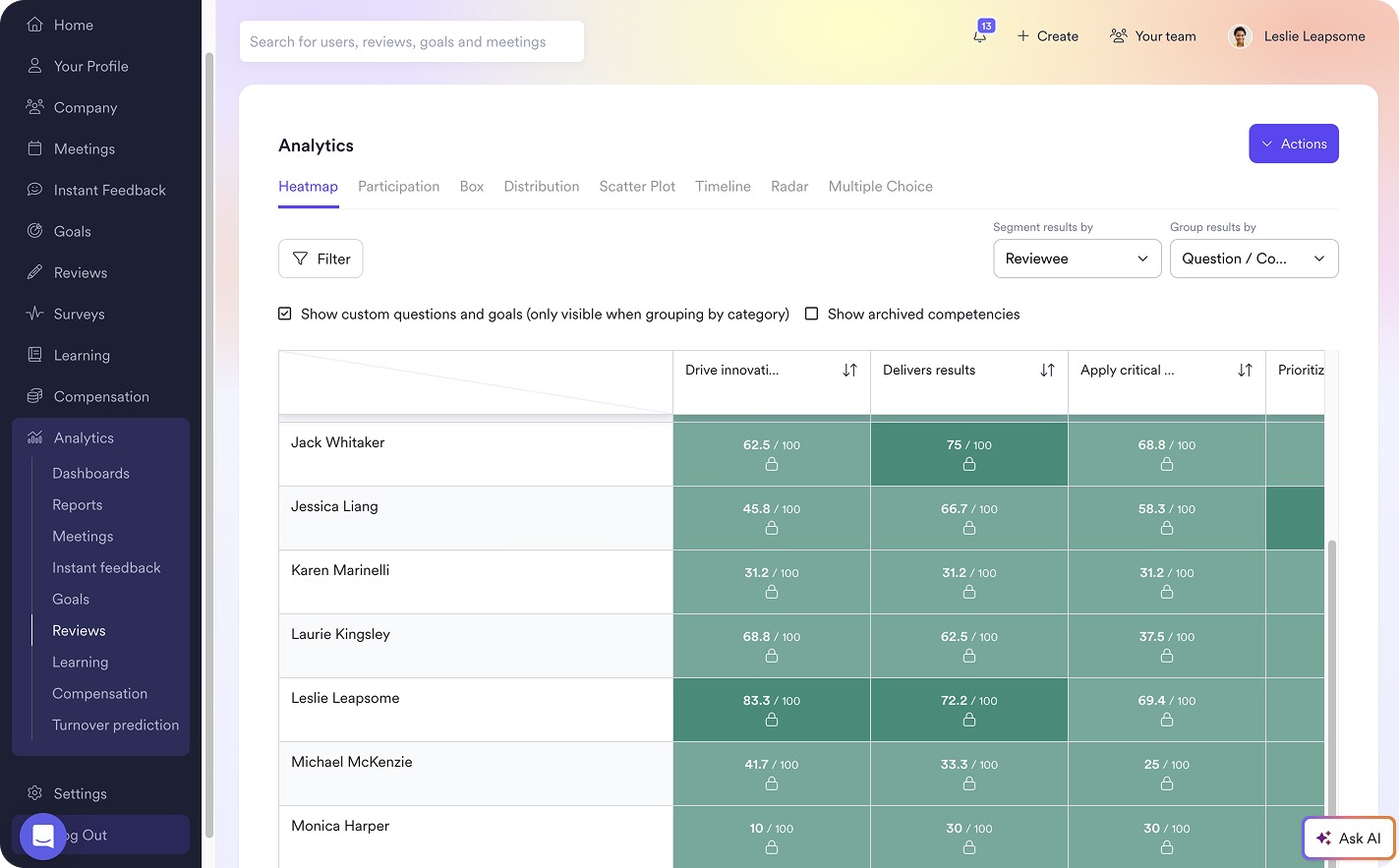
🖼️ Align pay decisions with the bigger picture
Leapsome comes with customizable, AI-assisted performance reviews that plug directly into compensation planning, workforce analytics, and career development — all in the same unified platform.
👉 Explore Performance Reviews
Take compa-ratios to the next level with Leapsome
Compensation decisions are most effective when grounded in pay data, performance metrics, and workforce planning goals. When made in isolation, compensation decisions tend to become reactive and inconsistent, potentially widening pay gaps and even hurting retention.
Leapsome’s AI-powered HR platform connects compensation decisions with the full context they need to truly make sense: performance management, people analytics, and workforce insights. HR teams get the tools to make more informed and equitable compensation decisions by:
- Improving compensation planning: Use Leapsome’s Compensation Management to build reusable templates and automate compensation review cycles for fairer, faster decisions backed by the data.
- Eliminating pay inequities: Support equal pay by exposing compensation trends across characteristics like gender and seniority to spot and correct unjustified pay gaps.
- Strengthening workforce analytics: Bring performance data and goal tracking under the same roof as engagement and compensation for interconnected insights with Leapsome’s Analytics.
- Connecting performance with rewards: Stop making decisions in a vacuum by tying merit increases and promotions to Performance Reviews and Goals & OKRs.
💰 Where compensation meets context
See for yourself how Leapsome gives HR teams the firepower to turn compensation data into fair, defensible pay decisions anchored in performance, engagement, and workforce insights.
👉 Request a demo
FAQ
What’s a good compa-ratio?
Many organizations consider a compa-ratio reasonable if it falls within 80% to 120%. But leaders should make compensation decisions with full context, including an employee’s experience and performance.

.jpg)



.jpg)