How we pay at Leapsome — and why we built it in our own product
.jpeg)
.jpg)
Most companies talk about pay in two registers: vague reassurance ("we pay competitively") or total silence. Neither is useful to the person trying to decide whether to join you, stay with you, or trust you.
In the current pressure we’re feeling from AI Transformation, ignoring the relationship between performance, competition, impact, and compensation is not viable. We must address compensation more strategically and more urgently than ever before. Here at Leapsome, we want to give People Leaders the tools to meet that challenge head-on, so this blog gives both an overview of how we approached it in our team, how we built it on our platform, and a tool you can use to do the same.
At Leapsome, our mission is to make work fulfilling for everyone. We’re building the HR techstack I’ve been longing for my entire career: AI-native, spanning talent, performance, compensation, and enablement. Making work fulfilling also means having strong convictions in the workplace we’re building for the Leapsome team, and building it in public for other leaders, all on our own platform.
It made perfect sense for me to start at the pointy end, right at the core of the relationship we have with work: Compensation.
So,we published our Compensation Philosophy and a tool that helps you build your own under the microscope of Global AI-Transformation: the actual mechanics of how we decide what to pay people, and what that means for everyone in our team, and everyone who wants to work with us. Here's what's in it, and why we built it the way we did.
We paid people before they asked
When we finished building the framework, we didn't wait for review cycles or resignation letters. We ran every team member's current pay against the new bands and adjusted proactively, across the board, regardless of performance.
This matters because the alternative (reactive adjustment, triggered by someone threatening to leave) is a failure mode, not a feature. It rewards whoever's willing to make the loudest noise, which is rarely correlated with who's creating the most value, and it's a well-documented way to quietly underpay the people least likely to ask: often your most underrepresented team members.
How the bands actually work
.png)
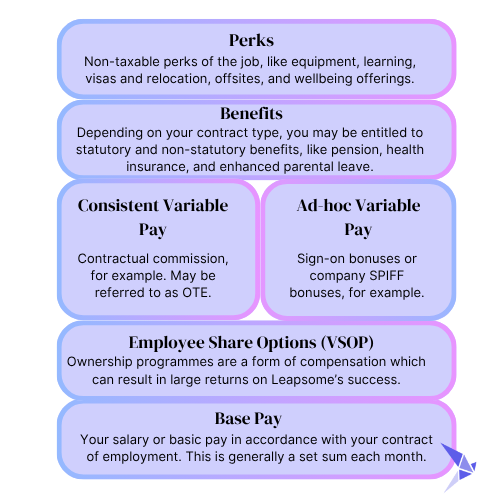
Every band is built from five inputs: location, function, level, a market benchmark, and (where genuinely warranted) a strategic adjustment for roles where the framework hasn't caught up yet.
The benchmark itself comes from Ravio as our primary source, cross-referenced against Pave and Mercer, set at the 75th percentile of technology companies at our stage (up to ~£100m ARR, up to Series B funding). We're not benchmarking against "the market" in the abstract… we're benchmarking against who we're actually competing with for talent.
Why we don't negotiate offers
We post salary bands. We discuss expectations in the first interview. And once we make an offer, it's not a negotiation.
This isn't rigidity for its own sake. Negotiation is a bias-inducing step. It systematically rewards people who are comfortable asking for more — a trait correlated with confidence and circumstance, not with the value someone brings — and it penalizes everyone who doesn't push back, often for reasons that have nothing to do with their work. A framework you can negotiate around isn't a framework. It's a starting offer with a discount built in for anyone who doesn't argue.
Why IC4 and IC5 exist
We're building Leapsome for a world where AI changes what "senior" means for an individual contributor. The old model, and one we think is actively outdated… for most of our careers, the only way to keep earning more is to become a manager. It doesn't hold up when a single highly capable, AI-augmented contributor can have outsized leverage without ever picking up a direct report. The world is changing, and we’re making an opinionated bet in our team at the frontlines of this change.
So we built levels (IC4 and IC5) that let compensation keep climbing with impact, not with headcount managed. If your output keeps compounding, your pay should too.
We built this on our own product
Every band, every level, every review cycle described in this philosophy runs through Leapsome's own HRIS, including the AI-enabled compensation tooling we sell to customers. We didn't build this philosophy and then bolt on a system to administer it. We built the system first, used it on ourselves, and only then decided it was good enough to put our name on.
If our own compensation model doesn't hold up under our own product, it doesn't ship to customers.
Why publish any of this
Not because transparency is fashionable. Because the moment two people on your team can't understand why they're paid differently, you've created a distraction from the work that matters, and that's on the company to fix, not the individuals to quietly resent.
Read the full Compensation Philosophy, including how we calculate base pay, handle cross-functional roles, and review bands over time. And if you want to see it in action, our open roles carry published bands, every time, we’d love to see you apply to join the team: we are actively hiring in Berlin and New York City, and have generous relocation packages to boot.
If you’d like to build your own, I’ve made this tool to take you from abstract to agenda.
📊 Build a compensation philosophy you can actually defend
Map your organization across five spectrums of org design and get a tailored methodology covering data sourcing, percentile strategy, leveling, and review cadence. Bring the output into Leapsome's Compensation to refine it with real market data and run fair, consistent reviews.
👉 Build your compensation philosophy
Jessica Zwaan

.jpg)




.jpg)