Build high-performing teams using goals, feedback, and growth


Most HR professionals already know the core characteristics of high-performing teams: well-defined goals, frequent feedback, and ongoing development. Despite this, just 39% of employees say their managers are effective at offering clear developmental feedback, while only 41% feel their managers help them prioritize their work.*
Understanding what goes into nurturing high-performing teams was never the hard part. The challenge is instilling the right habits across teams, regardless of whether they have the strongest manager. That means turning behavioral goals into tangible day-to-day performance gains. This guide shows how to build those habits in a practical and repeatable way.
* Gartner, 2026
What separates high-performing teams from average ones?
A high-performing team is one that consistently outperforms expectations in business metrics like productivity and profitability. These teams succeed thanks to clear goals, continuous feedback, and effective employee development.
Traditional models often emphasize team dynamics, such as fostering psychological safety or leveraging “norming” and conflict resolution strategies to strengthen team-building. These factors matter, but they shift attention away from the specific characteristics that empower teams toward interpersonal relations instead.
“Busy doesn’t mean effective. True productivity starts with clarity on what success looks like and why it matters. When people see how their work connects to company goals, they find energy and meaning in what they do.”
— Priscila Bala, CEO, LifeLabs Learning
A more pragmatic high-performing team model concentrates on three core concepts:
- Clear, connected goals: Employees who know what’s expected of them have the direction and context to focus on high-impact work. Equally important is knowing that their work supports greater objectives up the ladder. A Deloitte survey revealed that less than a third (29%) of team members who don’t belong to a high-performing team say they understand how their work contributes to collective performance.
- Frequent, specific feedback and coaching: Team members who regularly receive meaningful feedback in growth- and blocker-focused 1:1s can change their approach before correctable mistakes become real problems.
- Continuous development: High-performing teams don’t stagnate. Each team member wants to get better, and each manager has skills and tools to cultivate that growth year-round.
The three systems behind high-performing teams
“The foundation of great management is relationship-building. You can have all the tools, but without connection, communication, and safety, performance will always suffer.”
— Anja Schauer, Global Head of Customer Success, Leapsome
Most teams fail to sustain high performance because they rely on individual effort and a handful of strong managers to drive collective performance. Well-known models like Tuckman’s stages of team development and Lencioni’s five dysfunctions explain how teams evolve and adapt. But they don’t address how to make strong performance repeatable across many teams.
Getting this right takes a systematic approach. Here’s a look at the underlying systems that make developing high-performing teams achievable at scale:
- A goal-setting system: High-performing teams rely on a shared organizational framework for setting, tracking, and revising goals. This provides a standardized process that connects individual goals to team and organization-wide objectives. Without a shared framework, alignment depends on whether each manager takes the time to regularly go over the bigger picture. When they don’t, it’s easy for teams to end up working in isolation while goals become outdated.
- A feedback and coaching system: Manager conversations should follow a structured, repeatable program that leaves some room for personal coaching styles. When teams lack this structure, the quality and frequency of coaching conversations comes down entirely to individual manager effectiveness. That’s a major risk, since Gallup research shows that manager quality accounts for 70% of variance in team engagement.
- An employee development system: Clear development goals tied to well-defined competencies give every team member a straightforward and achievable path to growth. Targeted learning programs and regular check-ins help employees build skills and measure progress. Without a way to track growth between formal review cycles, skill gaps persist longer than necessary.
Leapsome offers a streamlined way to build and connect all three essential systems, starting with goal-setting.
“Competency frameworks are not just checklists. They’re roadmaps for growth and accountability. They help managers coach more effectively and give employees a clear picture of how to succeed at every level.” — Monica Sarkar, CoFounder, Purple Umbrella
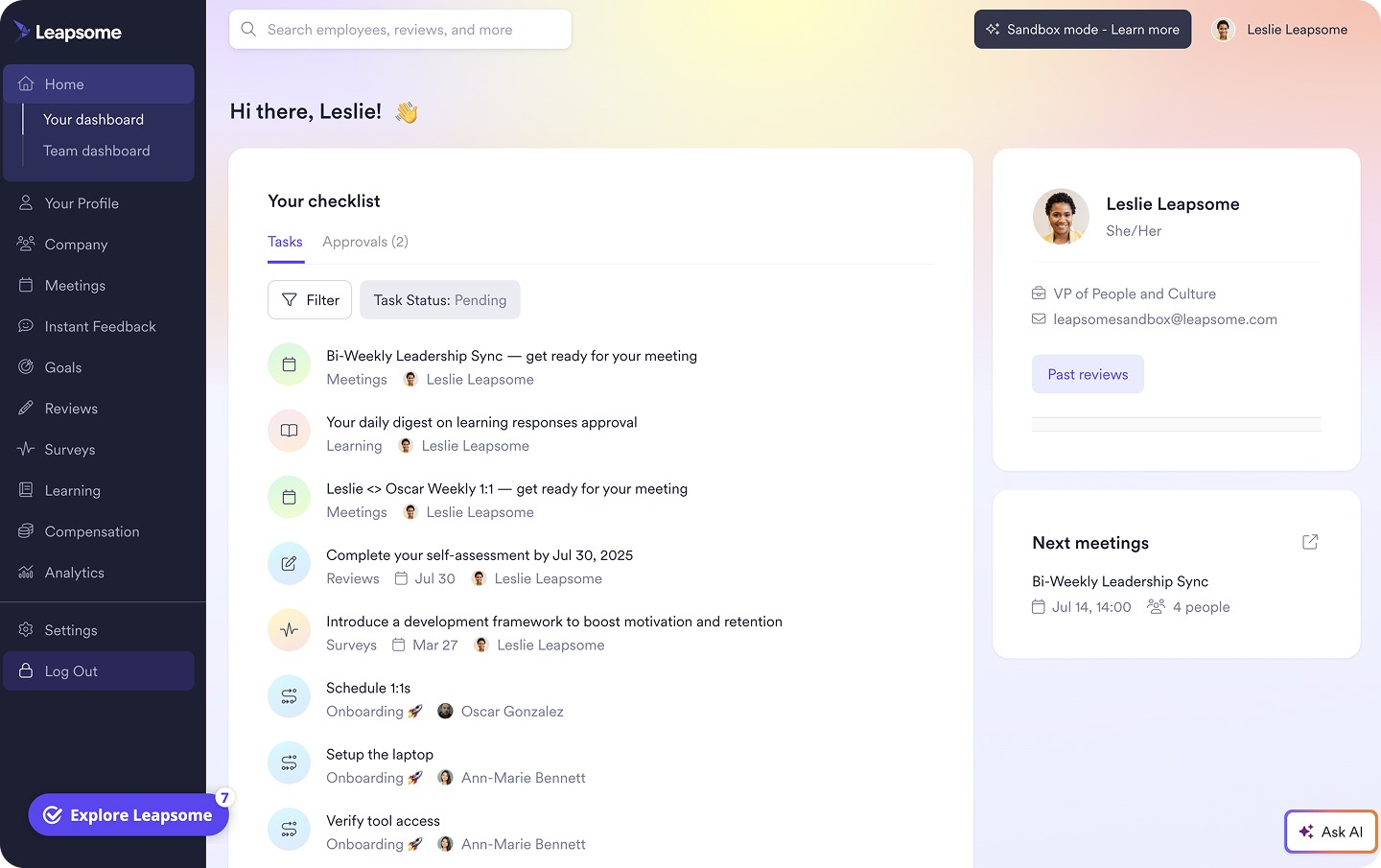
🎯 Stop reconstructing goal hierarchies by hand
Tie individual, team, and company goals together into one shared vision so managers can show at a glance how high-level objectives build on each individual team member’s hard work.
👉 Explore Goals & OKRs
Tips for embedding high-performance systems in everyday work
Follow these easy-to-implement best practices to build high-performing teams of your own:
- Give team members a voice: When team members help shape goals, they better understand expectations and develop a stronger sense of ownership and accountability. According to Gallup research, employees are almost four times more likely to be engaged when managers involve them in setting goals.
- Pair in-the-moment feedback with structured 1:1s: Timely feedback gives teams contextual guidance that helps them resolve issues before productivity drops. Research by Eagle Hill Consulting shows that 63% of employees want more in-the-moment feedback, but almost half receive performance feedback only on an annual or semiannual basis.
- Track development progress continuously: Instead of reviewing progress only when another review cycle rolls around, make growth a regular topic of conversation in ongoing 1:1s. Document progress and note what’s moving it forward or blocking it so measurements pick up seamlessly from one conversation to the next. Continuous learning and development is tough to achieve if there are long gaps between check-ins.
Leapsome helps organizations embed in-the-moment feedback and structured 1:1s into company culture by building them directly into the same software teams use every day.
“Too many organizations collect feedback that never sees daylight, and that’s where engagement dies. When you share results quickly, involve leaders in decisions, and clearly communicate the actions being taken, employees can see their input creating real change.”
— Monica Sarkar, CoFounder, Purple Umbrella
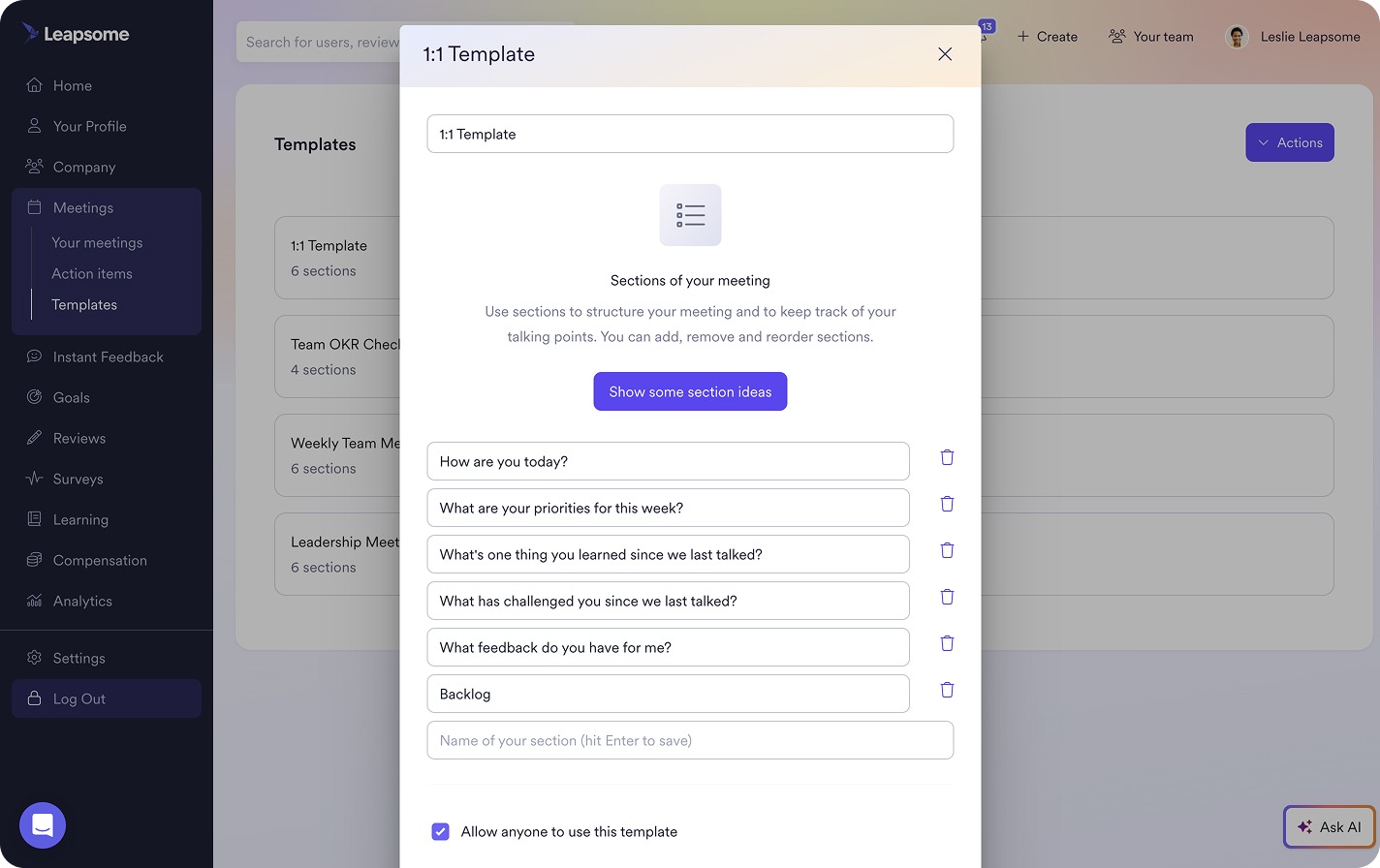
💬 Ensure consistent manager conversations every time
Instead of forcing them to improvise, give managers built-in meeting frameworks to enable constructive 1:1s, effective coaching conversations, and in-the-moment feedback.
👉 Explore Continuous Feedback and 1:1 Meetings
Build systems that power high-performing teams with Leapsome
Many HR leaders can name the characteristics of a high-performing team. Getting those characteristics to show up consistently once an organization grows past a handful of strong managers is a different story. It takes systems that clarify expectations, keep feedback flowing, and enable ongoing employee development. It also takes the right tools to put those systems into everyday practice.
Leapsome gives HR teams a single connected platform that covers all the bases:
- Goal-setting: Use AI-powered Goals & OKRs to link individual and team goals to overarching organizational objectives through flexible goal processes and frameworks. Conduct customizable Performance Reviews to continuously measure progress.
- Feedback and coaching: Let managers offer in-the-moment guidance and recognition through Continuous Feedback, as well as more detailed coaching through structured 1:1 Meetings. Run Engagement Surveys to diagnose which teams might need extra support.
- Continuous development: Design personalized Learning programs or choose from an expert-curated library of courses to foster ongoing employee growth.
“Employee engagement, feedback, and good goal setting processes are the rocks that every company needs as the basis to support their growth.” — Benjamin Böhmer, Director of People & Culture Group, heycar Group
🚀 Lay the groundwork for high performance without the manual labor
Build comprehensive goal-setting, feedback, and learning and development systems into your organization’s daily workflows to cultivate high performance that stands the test of time.
👉 Request a demo
FAQ
How can I build a high-performing team?
Learning how to build a high-performing team starts with understanding the key characteristics these teams have and the supporting systems behind them, namely:
- Clear, connected goals: Use a shared goal-setting framework that keeps those goals aligned across the individual, team, and organizational levels.
- Frequent, specific feedback and coaching: Combine in-the-moment guidance with structured 1:1s.
- Continuous development: Create straightforward growth paths, tailored learning programs, and continuous progress tracking.